
How to choose an e-commerce platform for your online store

Contents · 8 sections
- What is an e-commerce platform, and why does…
- Which platform is right if you don’t have…
- SaaS vs. open source: how do they compare?
- WooCommerce, Shopify, GombaShop or something else? What to…
- What features should a good e-commerce platform offer?
- What will it really cost?
- What you need to know about hosting, security…
- How to make a final choice you won’t…
Before you upload your first product or run your first ad, there’s a bigger question to answer: which platform will you choose for your online store? Your platform is the foundation of the whole business. It decides how your store looks, how it works and how far it can grow.
If you’re trying to figure out the best platform for an online store, you’re probably feeling a mix of excitement and nerves. That’s completely normal. This isn’t just a technical detail. It’s a strategic decision about the future of your business.
What is an e-commerce platform, and why does it matter so much?
An e-commerce platform is a software system that lets you create, manage and grow an online store. It covers everything you need: a product catalog and shopping cart, payments, shipping, customer accounts, SEO and more.
It’s where your online business will “live,” and it determines:
- how easily you can add products;
- whether you can change the design;
- which integrations you get (payment systems, couriers, marketing tools);
- whether the site will be fast, secure and mobile-friendly;
- and, just as important, whether you’ll get help when something goes wrong.
Your platform should work for you, not hold you back. If you’re fighting the interface, the technical settings scare you or you can’t make the store look the way you want, it’s the wrong tool.
Which platform is right if you don’t have technical skills?
If you’re not a developer and have never built a website, choose a platform with an intuitive interface and ready-made templates. These are known as SaaS solutions (Software as a Service): systems you don’t have to install, host or maintain yourself.
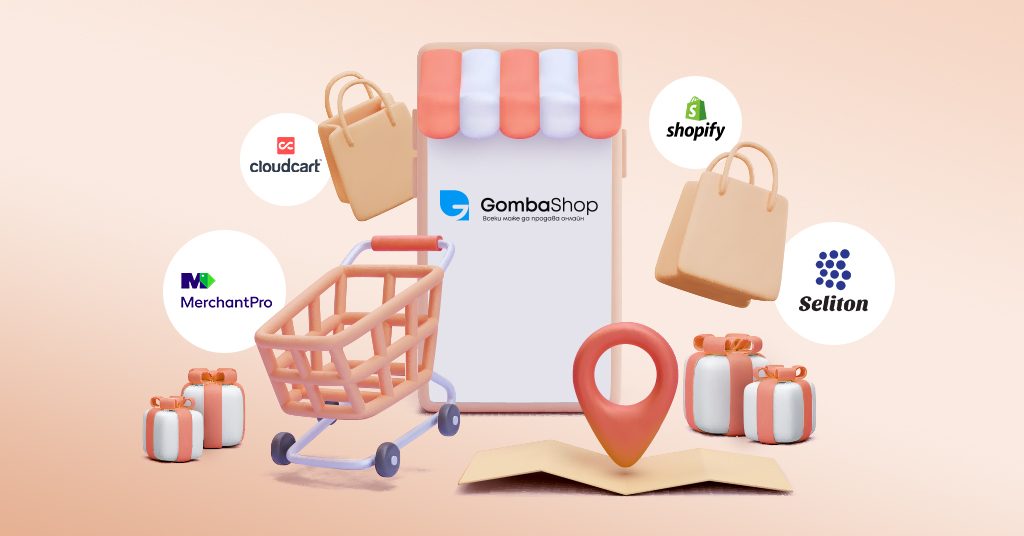
The most popular SaaS platforms include:
- Shopify: the global leader, with great support and a huge selection of apps
- GombaShop: a clean, practical and very affordable Bulgarian platform built for a fast start and easy content management.
- Seliton: another Bulgarian option for small and midsize businesses, with local support and solid integrations.
- CloudCart: a Bulgarian platform designed for selling online in Bulgaria.
- MerchantPro: a Romanian platform with an office in Bulgaria, tailored to Bulgarian businesses.
These platforms are designed so that anyone can launch an online store in just a few days. You get drag-and-drop builders and ready-made designs, and adding products and payment methods is easy.
You don’t need any technical skills, which is a huge advantage when you’re just starting out. The biggest benefit?
You can focus on sales, marketing and the customer experience instead of technical details.
SaaS vs. open source: how do they compare?
SaaS platforms are subscription services: hosting, security and maintenance all come with the monthly fee. Open-source platforms take more technical work, but they give you more flexibility.
Here’s how the two stack up:
SaaS (Software as a Service)
- No installation or technical skills required.
- Everything is included: hosting, security, updates, support.
- Customization and integrations are usually more limited.
- A good fit for small and midsize businesses that want to launch quickly and safely.
- A good way to test and validate an online business, a product or a product line.
- Examples: Shopify, GombaShop.
Open source
- Requires technical know-how, your own hosting and regular maintenance.
- No limits: you can customize every corner of your store.
- Lower monthly costs, but higher upfront costs.
- A good fit for businesses with specific needs or higher sales volume.
- Examples: WooCommerce, OpenCart, Magento, PrestaShop.
If you don’t have a team or technical know-how, SaaS platforms are the safer choice. If you need unique features and flexibility, open source is the way to go.
WooCommerce, Shopify, GombaShop or something else? What to choose based on your goals
There’s no universal “best platform.” There’s only the one that fits your needs best.
Here’s how to think about it:
- Want a fast local option built for the Bulgarian market and its regulations?
GombaShop gives you exactly that: a quick, all-inclusive start, local integrations included, at a very affordable price. - Building a store for international markets?
Shopify will save you time and headaches. You get a secure environment, easy setup and good-looking templates, plus a rich set of tools and integrations. - Want control, strong SEO and an open-source foundation?
OpenCart is free, flexible and backed by a large ecosystem of plugins and themes. But you’ll need either the know-how yourself or a technical partner. - Planning a large store with thousands of products and a team behind it?
Magento (Adobe Commerce) is built for you. It lets you customize every last detail, but it also demands the most in resources and people. - Want to launch a store with just one product or a handful?
Then WooCommerce on WordPress is your answer.
Tip
Define your needs, budget, team and timeline first. Then pick the platform. Not the other way around.
What features should a good e-commerce platform offer?
It should cover more than the “e-commerce basics.” It should also give you room to grow and adapt to the market. A good system keeps working for you even when you’re away from the screen.
At a minimum, you need:
- Easy product catalog management: importing, grouping, filtering and SEO for every page;
- Payment integrations: card payments, cash on delivery, PayPal, Stripe or local solutions;
- Courier integrations: automatic shipping calculation, tracking and notifications;
- Flexible design and a mobile version: most people shop on their phones;
- Multiple languages and currencies: especially important if you plan to sell outside Bulgaria;
- Marketing features: discounts, coupon codes, campaigns, pop-ups, remarketing pixels;
- SEO capabilities: meta tags, URL editing, automatic sitemaps, redirects;
- Tools for analyzing and tracking customer behavior.
And finally, extensibility and customization. Without them, your store will hit a ceiling.
Tip
Choose a platform that lets you start fast and add features as you go.
What will it really cost?
Launching an online store costs more than the monthly subscription or the initial investment. The real price tag includes hosting, maintenance, updates, design, extensions and marketing.
SaaS platforms (subscription)
- Subscription: €14 to €80+ per month;
- Everything included: hosting, technical support, SSL certificate, updates;
- Limited design options, or extra fees for templates and integrations.
Open source
- Hosting costs: €6 to €30 per month;
- Initial development and setup: anywhere from a few hundred to tens of thousands of euros, depending on the size and complexity of the store;
- Extensions and plugins: often paid;
- You handle maintenance and security yourself.
And don’t forget the hidden costs: time, training, marketing, and software for inventory or shipping management.
Your platform doesn’t have to be cheap. It has to be the right fit. The cheap option often costs more in the end: once you outgrow it, you may have to start from scratch.
What you need to know about hosting, security and maintenance
Hosting is your store’s home. Security is its lock. Maintenance is your insurance.
With SaaS, hosting is included. You don’t have to think about servers, backups or updates, because the platform handles all of it. That means less stress and more time for your business.
With open-source platforms (WooCommerce, Magento, OpenCart), all of this is on you:
- Your own hosting: stable, fast and with PHP/MySQL support
- Security: SSL certificates, DDoS protection, a backup plan
- Updates: for the core, themes and plugins
- Technical support: if something breaks, you have to fix it (or pay someone who can)
Site problems cost you customers and revenue. Reliable hosting and support aren’t a luxury. They’re a necessity.

How to make a final choice you won’t regret six months later
Choose a platform that meets your needs today and gives you room to grow. Don’t decide on price or popularity alone. Look at practicality, flexibility and how easy it will be for your team to use.
Ask yourself these questions:
- Will I sell only in Bulgaria, or abroad too?
- Do I have the technical know-how, or a partner who can help?
- Will I need a custom design, or are ready-made templates enough?
- How often will I update my product catalog?
- Do I want to handle maintenance myself, or would I rather have it all “included”?
Answer these questions honestly, and the right platform will become clear.
Don’t go looking for the “perfect” system. It doesn’t exist. But there are platforms that will adapt to your business, save you time and give you the confidence to move.
Your platform is your first technical decision, and its job is to stay out of the way so you can focus on bigger problems. If setting it up takes more effort than actually selling, it’s the wrong choice. If it sounds great on paper but in practice slows you down, complicates things and holds you back, it’s probably not for you.
The goal isn’t to find the “perfect system.” It’s to find the one that lets you move forward calmly, without friction. Your platform won’t solve everything. It just shouldn’t stand between you and where you’re headed.
Petar Dyaksov
Entrepreneur and founder of a digital agency, in e-commerce since 2009. He grows online businesses such as Fragrances.bg and Timedix and shares his experience as a speaker, moderator and mentor at nearly 80 conferences and trainings.
More about me