
The end of digital agencies: evolution or decline?

Contents · 9 sections
On 16 October 2026, together with Dimitar Denev, CEO of SEOMAX, I took the stage at Digital4Plovdiv 2026 with the talk “The end of digital agencies: evolution or decline?”. We did not pick the topic for effect. It is a question we hear more and more often from clients and colleagues in the industry, and one we ask ourselves every day.
In this article I have gathered the main ideas from the talk. If you would rather see the slides, the full presentation is at the end of the article: you can browse it slide by slide or download it as a PDF.
The big question: what will clients pay for?
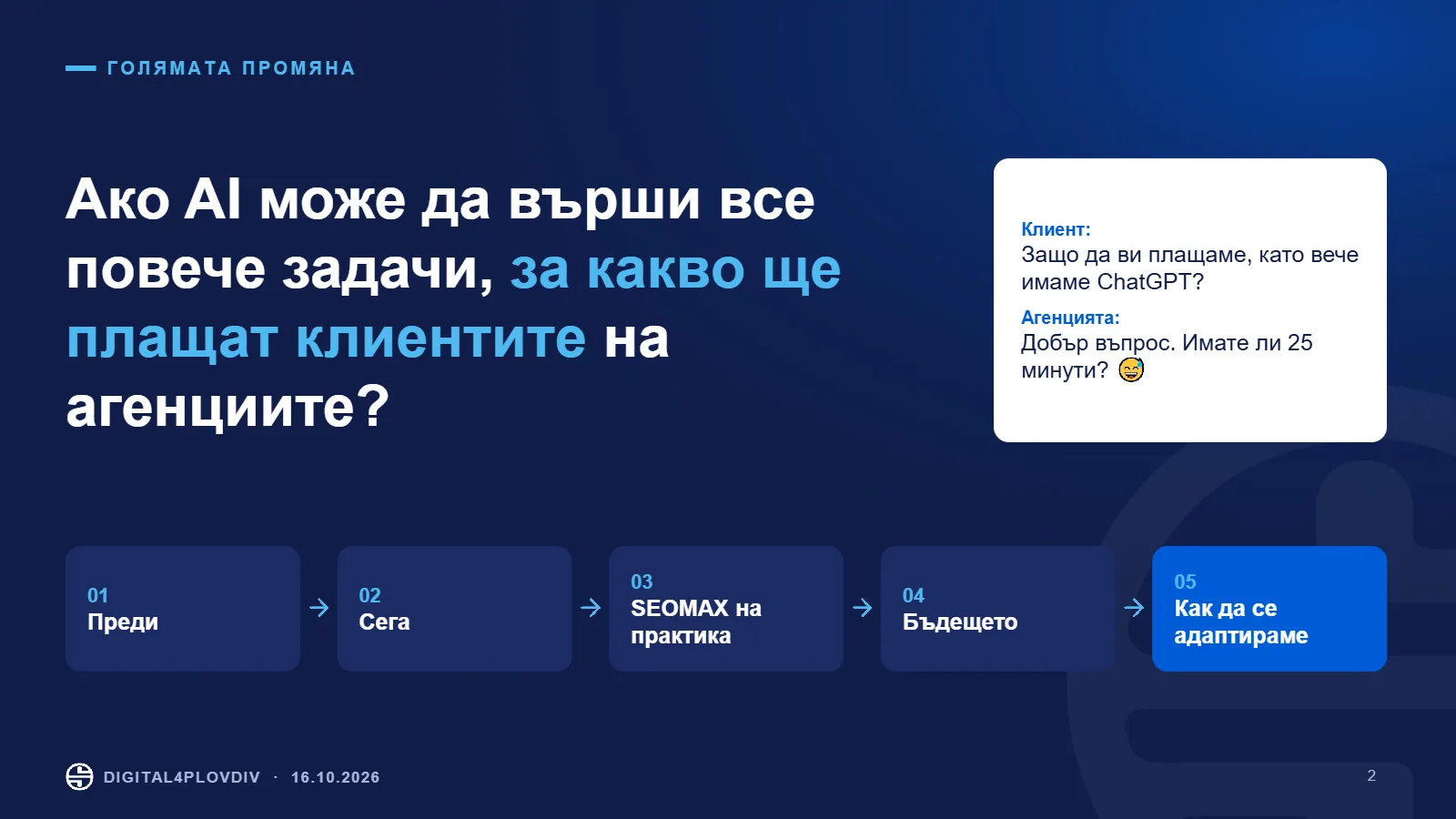
If AI can do more and more tasks, what will clients pay agencies for? We opened the talk with a dialogue many agencies have already heard:
Client: “Why should we pay you when we already have ChatGPT?”
Agency: “Good question. Do you have 25 minutes?”
The answer really did take 25 minutes on stage. Here I will try to fit it into a few parts: how agencies have worked until now, what is changing, how we do it in practice, what the agency of the future looks like and how to adapt.
How agencies have worked until now
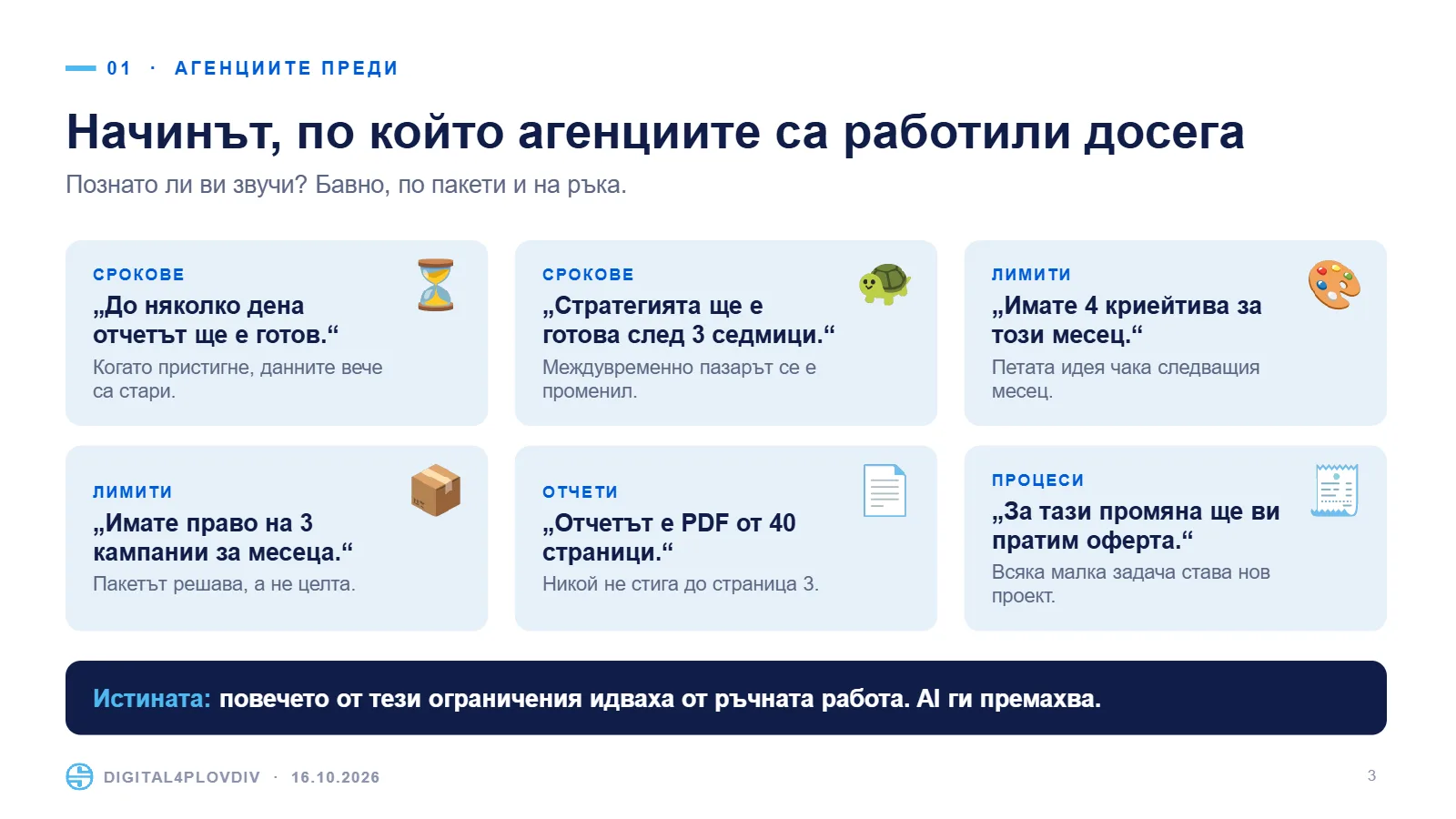
Slowly, in packages and by hand. You will probably recognise at least a few of these lines:
- “The report will be ready in a few days.” By the time it arrives, the data is already old.
- “The strategy will be ready in 3 weeks.” Meanwhile, the market has changed.
- “You have 4 creatives this month.” The fifth idea waits for next month.
- “You are entitled to 3 campaigns a month.” The package decides, not the goal.
- “The report is a 40-page PDF.” Nobody gets past page 3.
- “We will send you a quote for that change.” Every small task becomes a new project.
The truth is that most of these limits came from manual work. AI removes them.
AI changes not just the speed, but the work itself
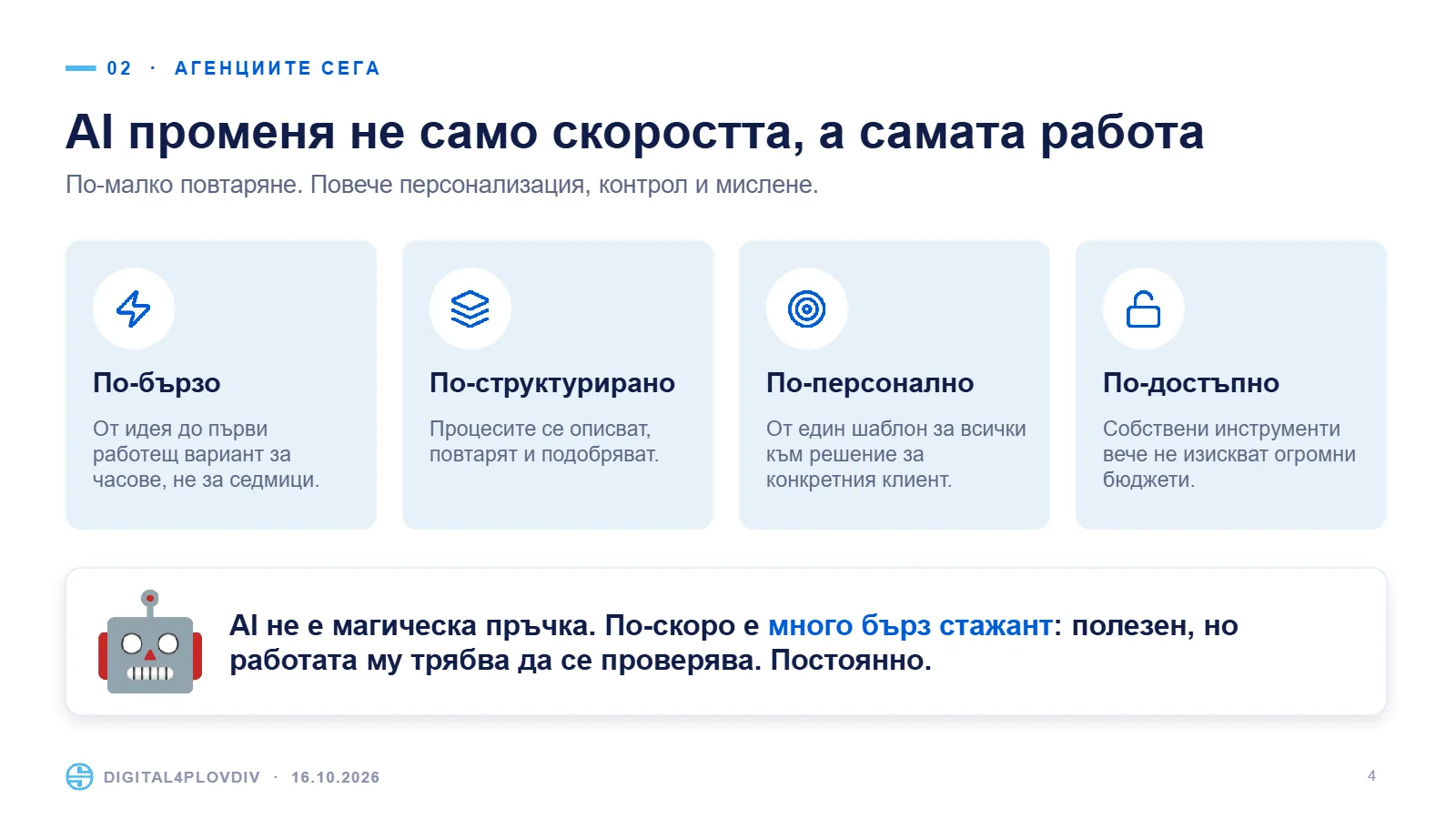
It is easy to think of AI as a way to do the same things, only faster. The change goes deeper than that. The work becomes:
- Faster: from idea to a first working version in hours, not weeks.
- More structured: processes get documented, repeated and improved.
- More personal: instead of one template for everyone, a solution for the specific client.
- More accessible: building your own tools no longer requires huge budgets.
AI is not a magic wand. It is more like a very fast intern: useful, but its work needs checking. Constantly.
A superpower everyone has is not an advantage
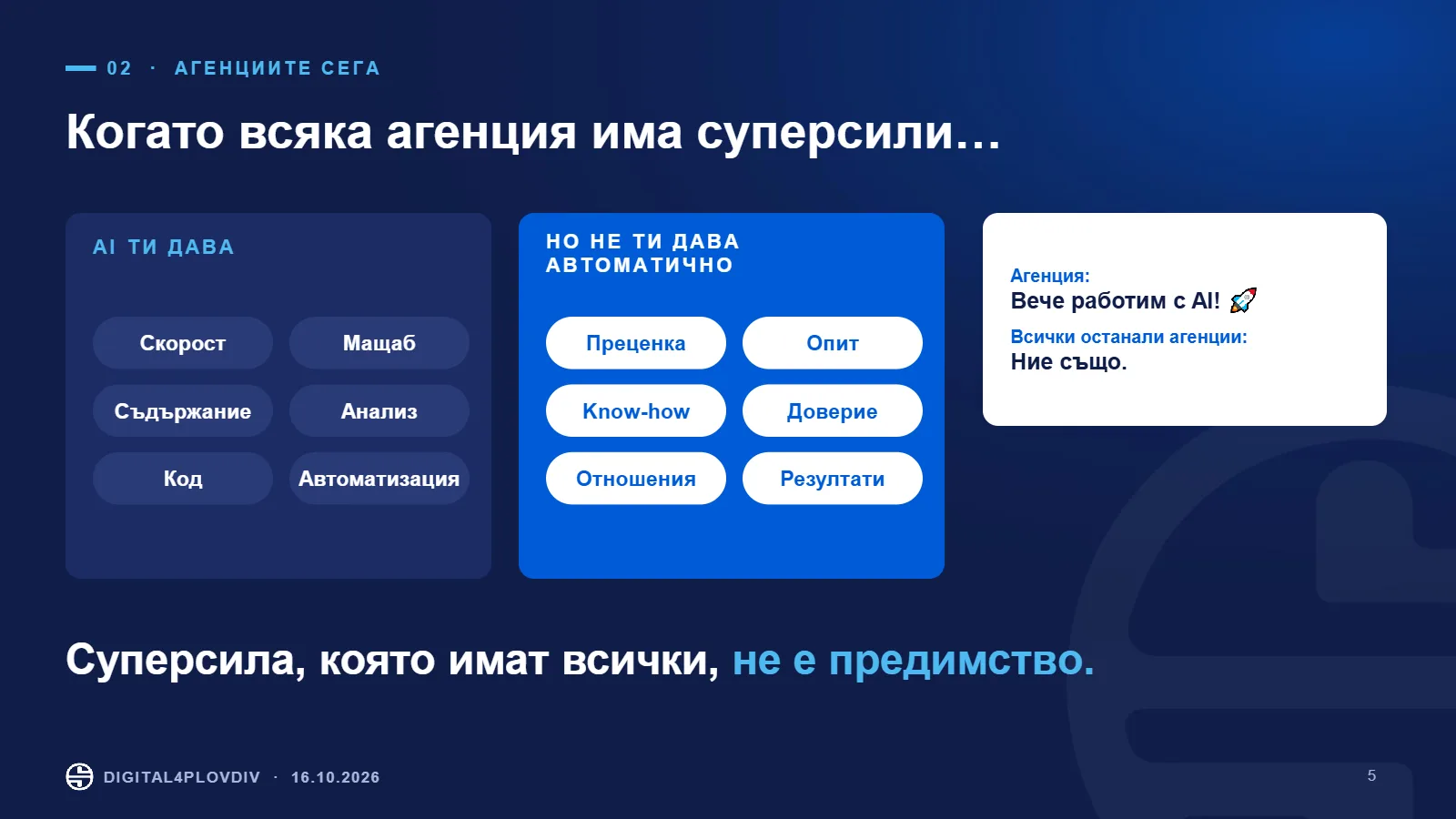
AI gives every agency speed, scale, content, analysis, code and automation. What it does not give automatically is judgement, experience, know-how, trust, relationships and results.
Today every agency says “We already work with AI!”, and all the others reply “So do we.” That is why the difference is no longer whether you use AI, but what you build with it.
How we do it at SEOMAX
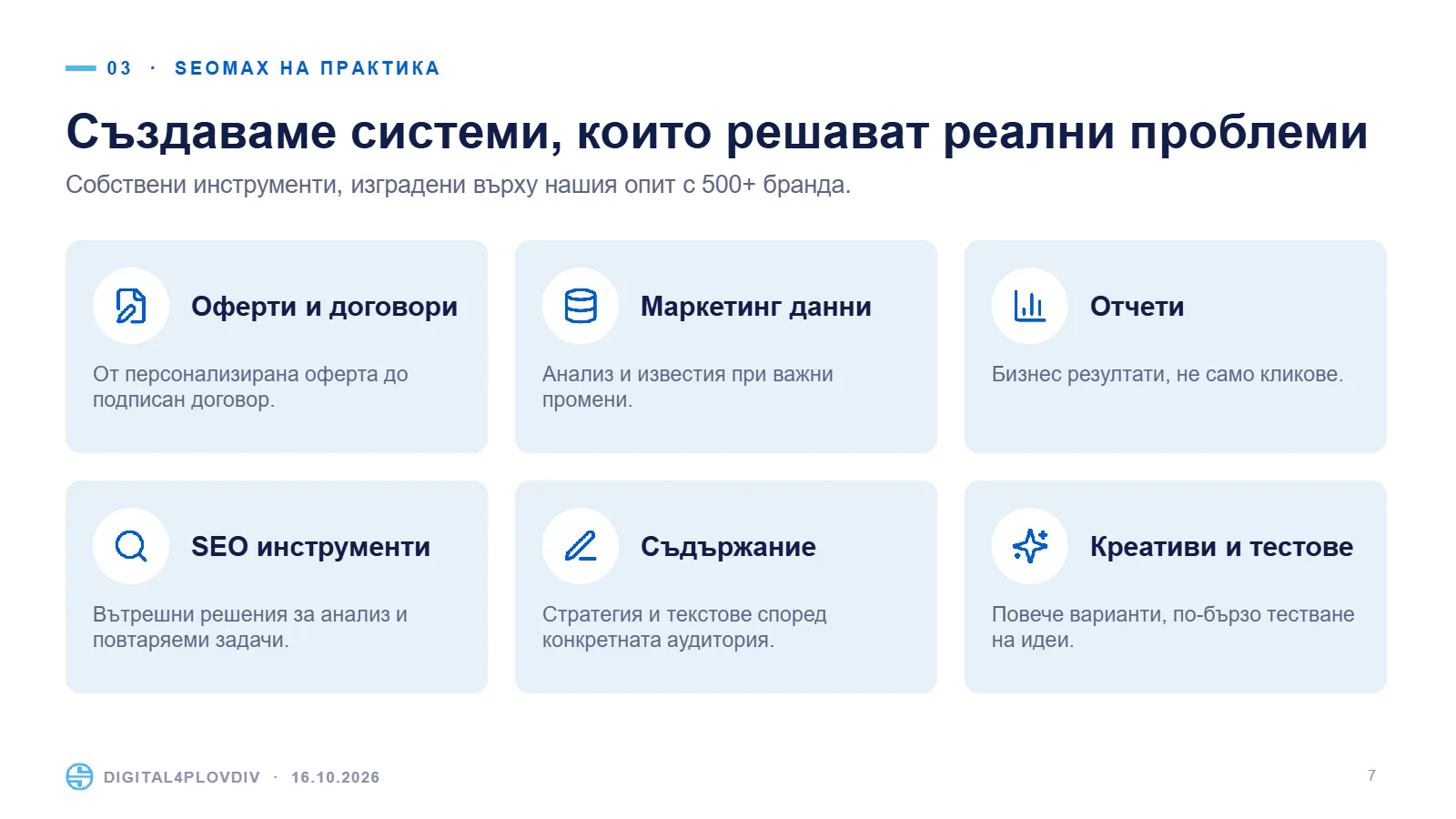
At SEOMAX we are not just adding AI. We are changing the way we work. Over the past year we have built our own systems on top of the experience we have gained with our clients, for the tasks that take the most time:
- Quotes and contracts: from a personalised quote to a signed contract.
- Marketing data: analysis and alerts when something important changes.
- Reports: business results, not just clicks.
- SEO tools: in-house solutions for analysis and repetitive tasks.
- Content: strategy and copy tailored to the specific audience.
- Creatives and tests: more variations and faster testing of ideas.
On stage we showed four of them.
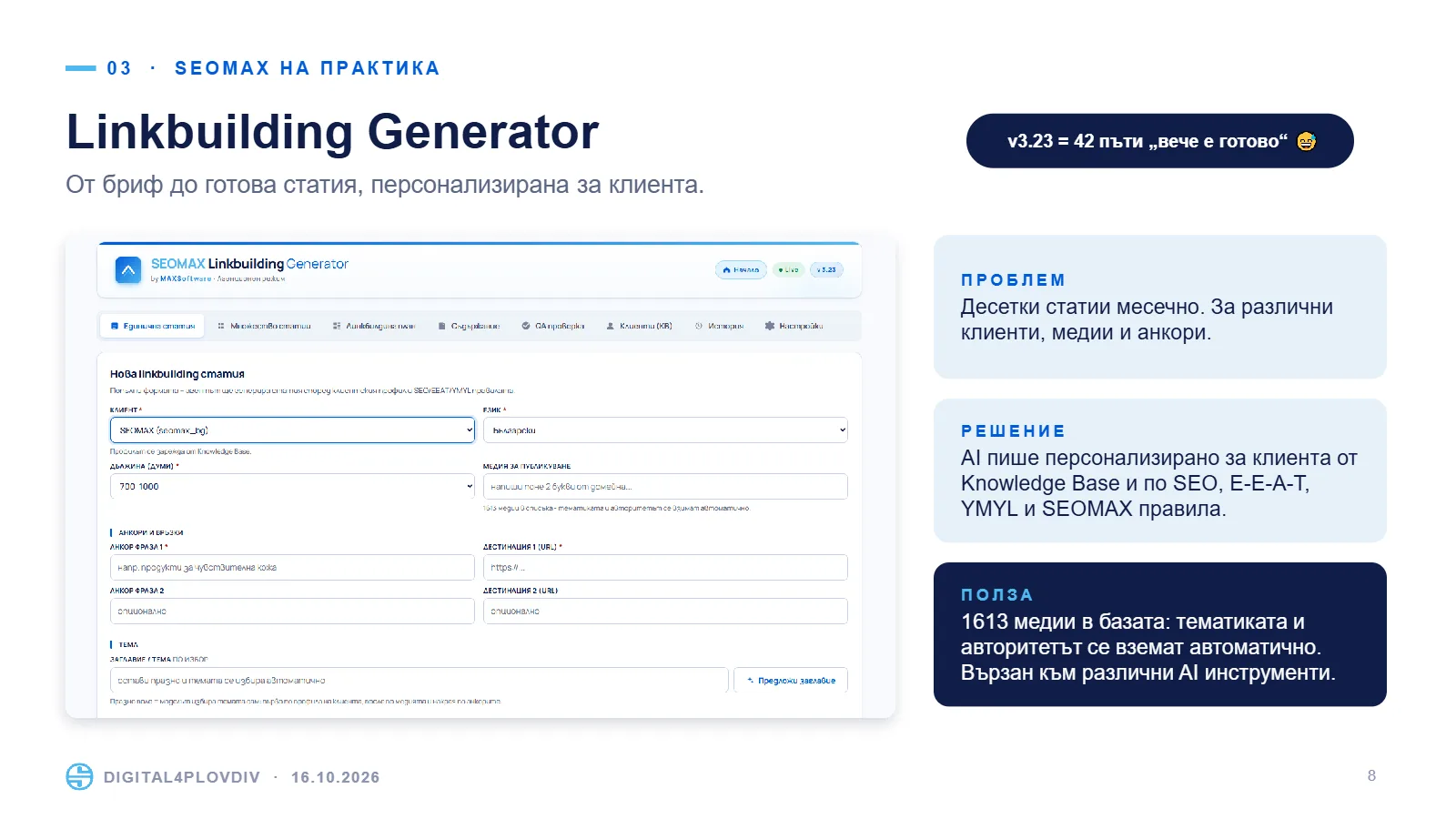
Linkbuilding Generator
Every month we write dozens of link building articles for different clients, media and anchors. The tool generates an article personalised for the client from their Knowledge Base profile, following SEO, E-E-A-T and YMYL rules as well as our internal standards. The database holds more than 1,600 media outlets, and the topic and authority of each one are picked up automatically.
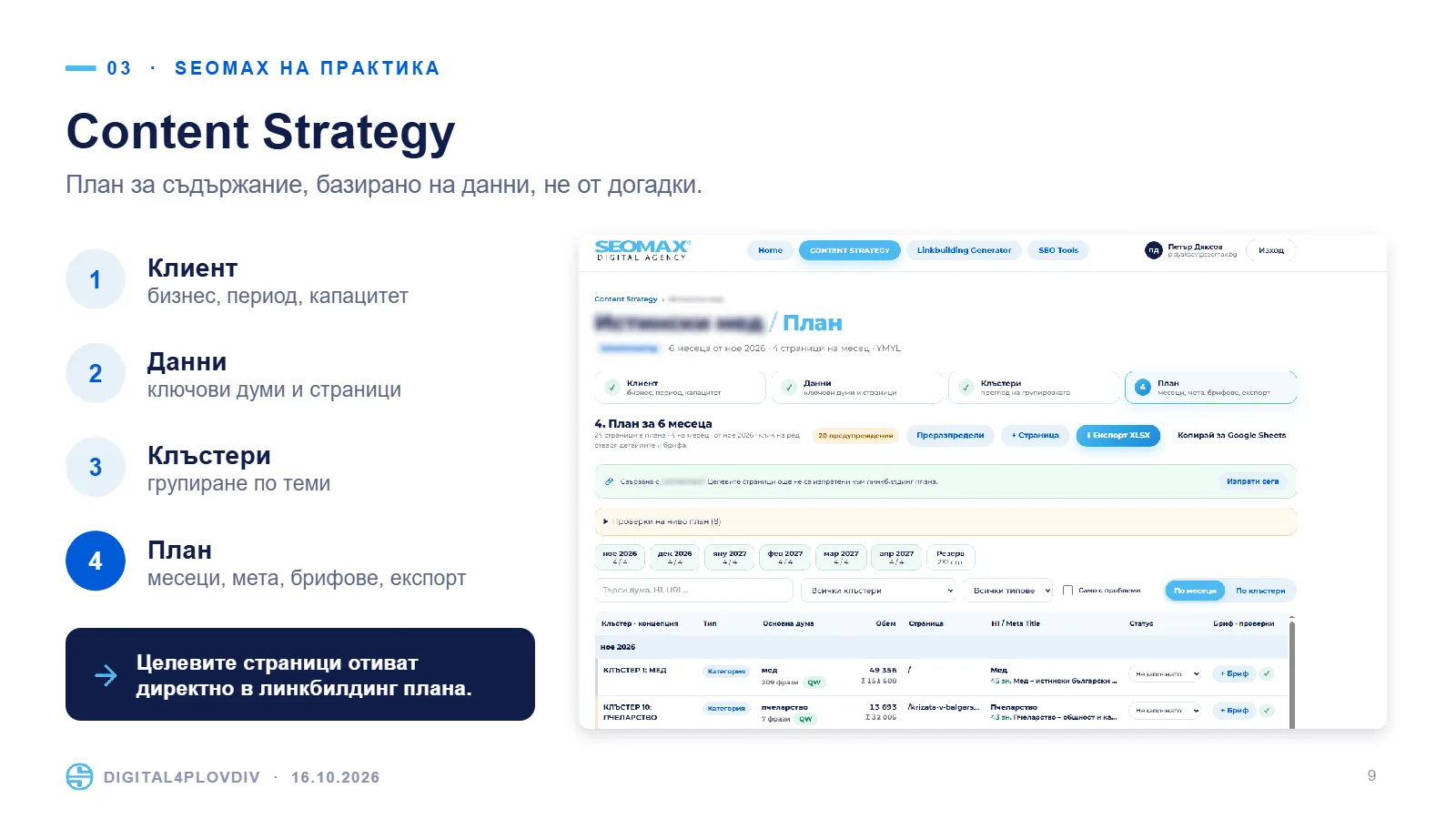
Content Strategy
A content plan based on data, not guesswork. It goes through four steps: client (business, period, capacity), data (keywords and pages), clusters (grouping by topic) and plan (months, meta data, briefs and export). The target pages go straight into the link building plan, so the two tools work together.
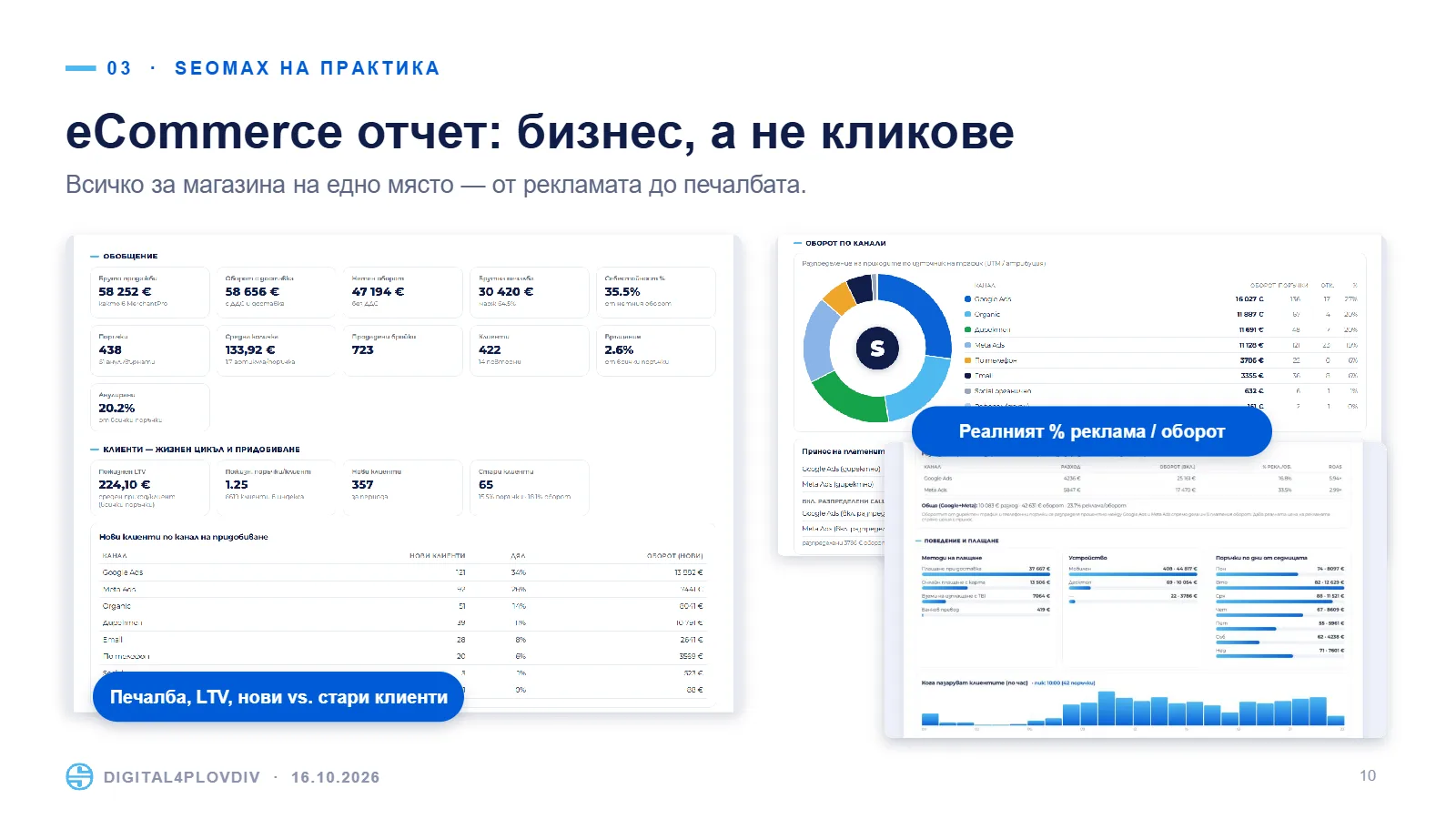
eCommerce report: business, not clicks
Everything about an online store in one place, from advertising to profit: gross profit, LTV, new versus returning customers, revenue by channel and the real share of ad spend in revenue. These are the numbers the owner cares about, not the number of clicks.
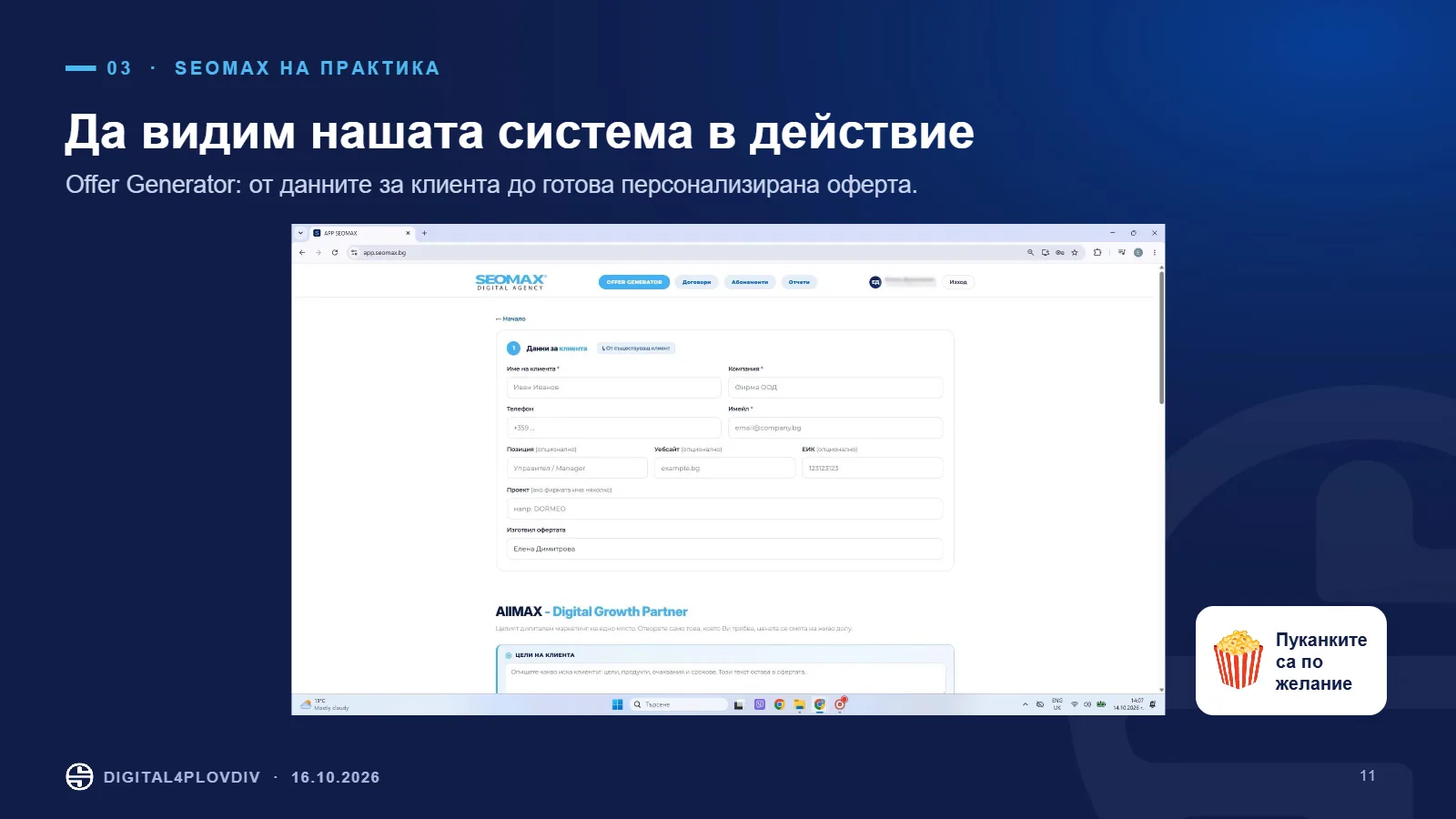
Offer Generator: from quote to signed contract
We wanted to demo this system live, but unfortunately the video would not start, so we talked it through instead. It covers the whole journey from the first conversation with the client to the signed contract:
- A personalised quote in real time: we enter the client’s details, their goals and the services they need, and the system prepares a quote tailored to their business.
- Sending and acceptance: the quote reaches the client right away and they can accept it online.
- A personalised contract: once the quote is accepted, the system generates a contract with the client’s details and the agreed services.
- Digital signing: the contract is signed online, with no printing, scanning or couriers.
A process that until recently took days and several back-and-forth emails is now much faster and automated.
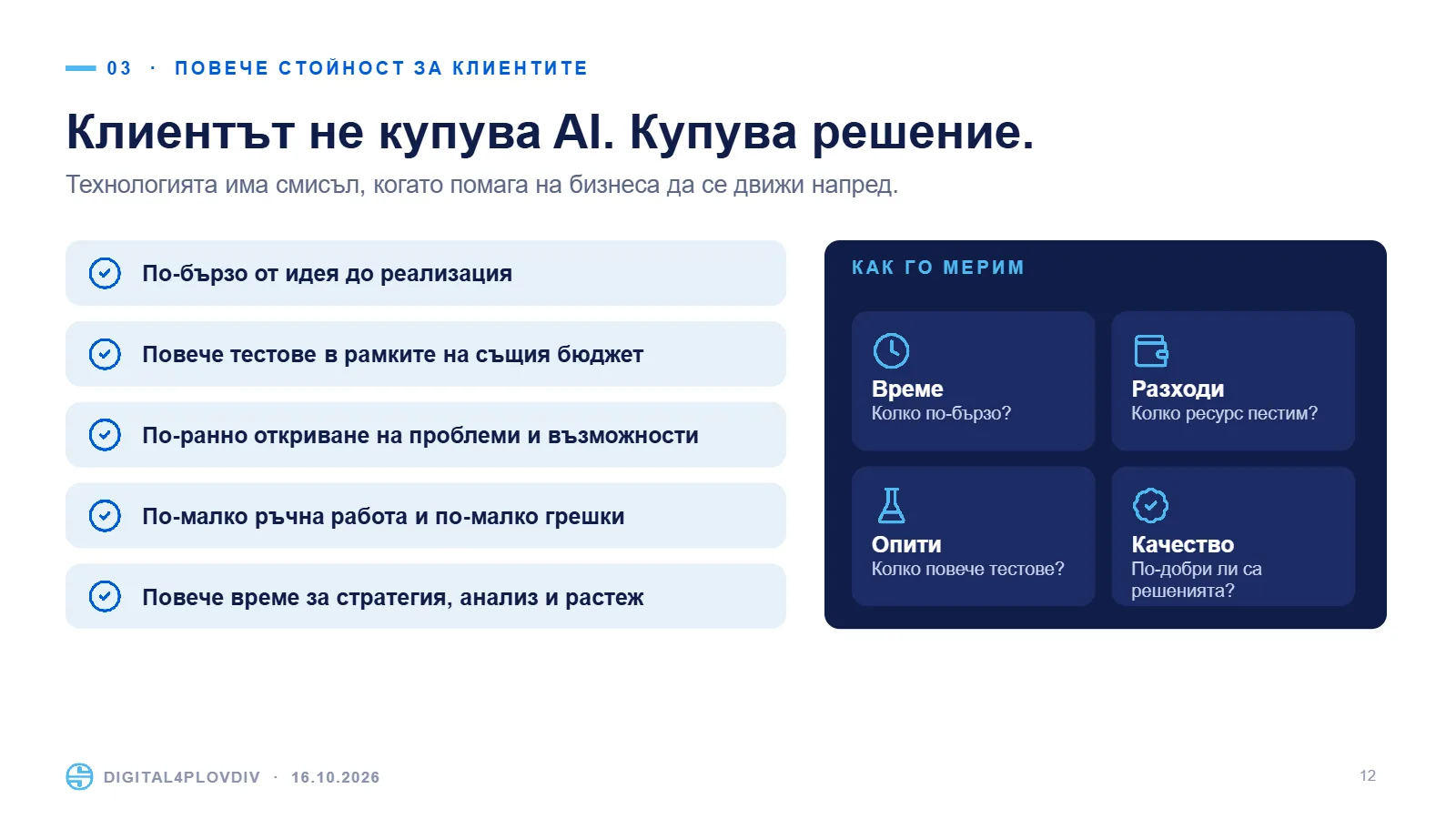
Clients do not buy AI. They buy a solution.
Technology makes sense when it helps a business move forward. For the client, that means:
- faster from idea to execution;
- more tests within the same budget;
- earlier detection of problems and opportunities;
- less manual work and fewer mistakes;
- more time for strategy, analysis and growth.
We measure the effect with four indicators: time (how much faster), cost (how many resources we save), experiments (how many more tests) and quality (are the decisions better).
The agency of the future
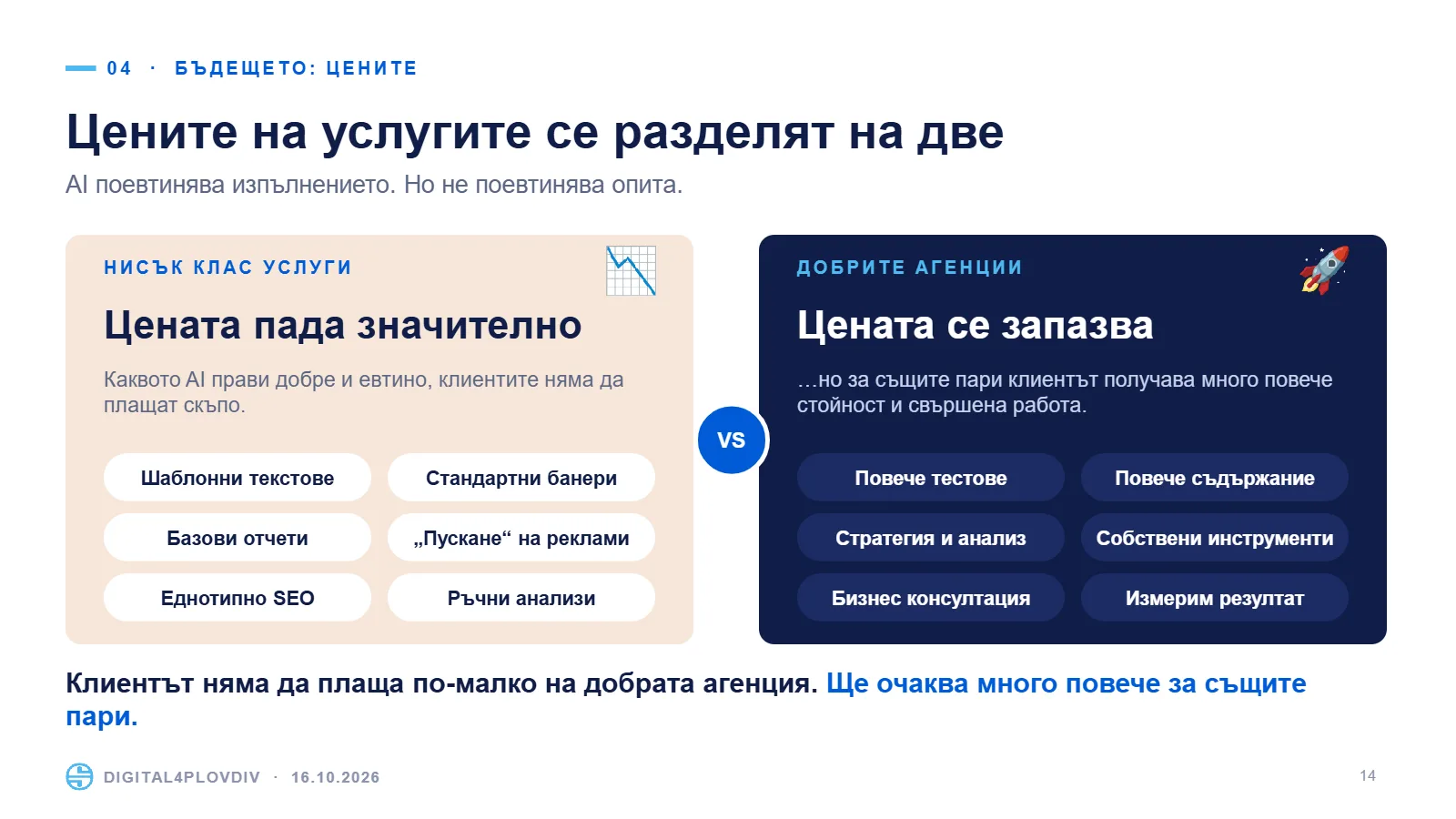
Service prices will split in two
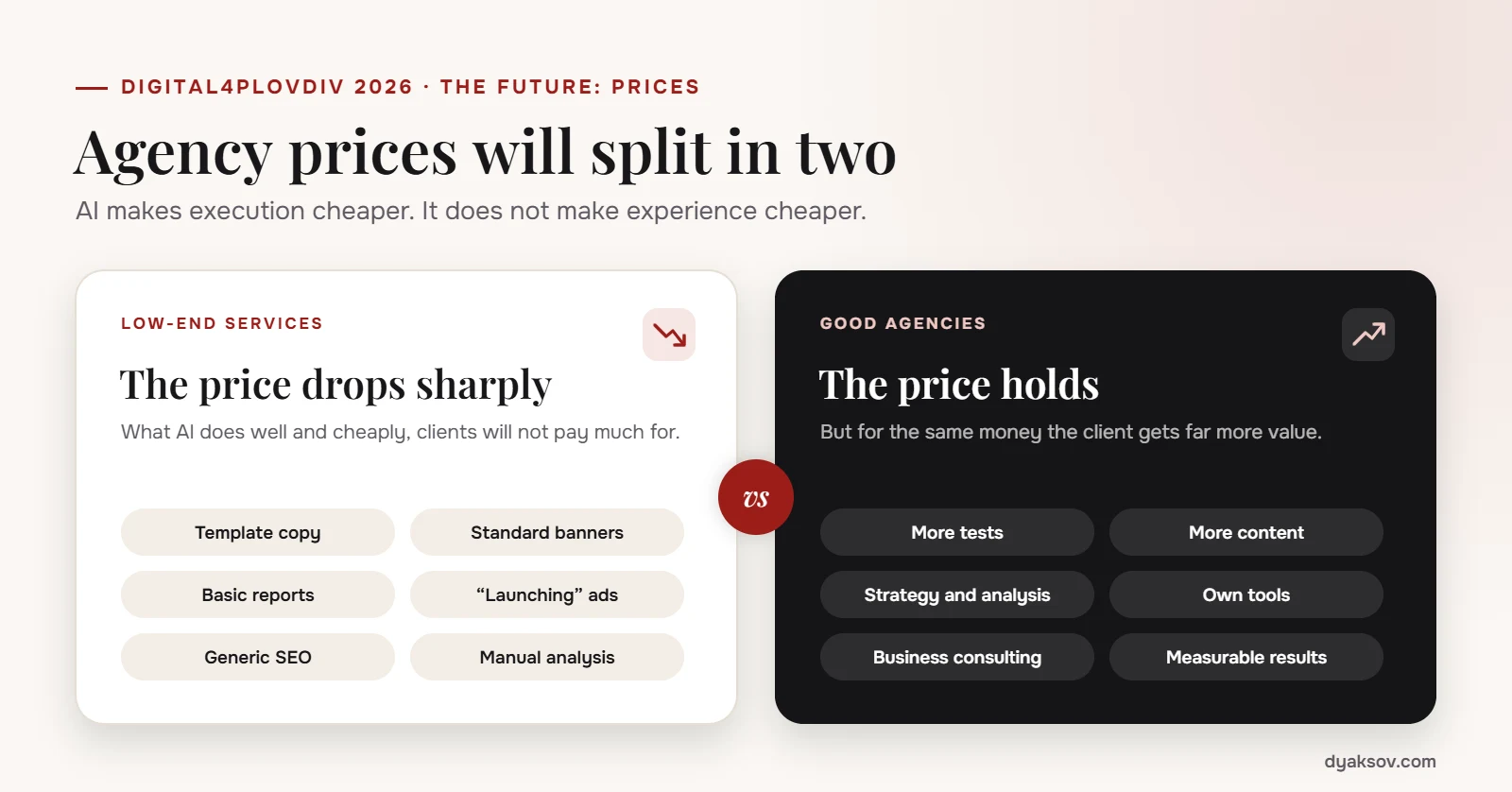
AI makes execution cheaper. It does not make experience cheaper.
For low-end services such as template copy, standard banners, basic reports, “launching” ads, generic SEO and manual analysis, the price will drop sharply. What AI does well and cheaply, clients will not pay much for.
With good agencies the price will hold, but for the same money the client will get far more: more tests, more content, strategy and analysis, proprietary tools, business consulting and measurable results. Clients will not pay a good agency less. They will expect much more for the same money.
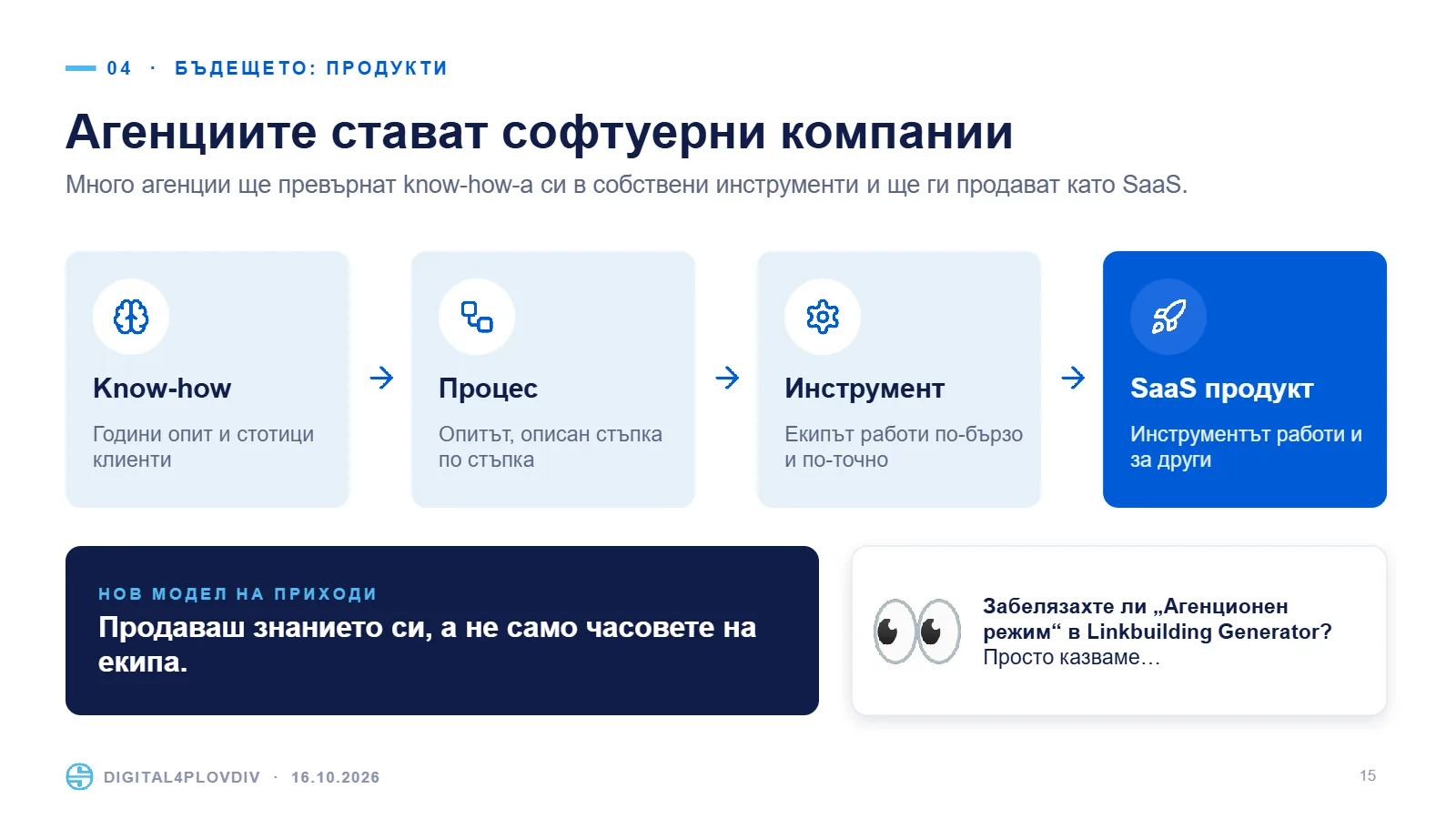
Agencies are becoming software companies
Many agencies will turn their know-how into their own tools and sell them as SaaS. The path looks like this: years of experience and hundreds of clients turn into a process described step by step. The process becomes a tool that helps the team work faster and more accurately. And then the tool starts working for others too.
It is a new revenue model: you sell your knowledge, not just your team’s hours. If you noticed an “Agency mode” in our Linkbuilding Generator, we are just saying…
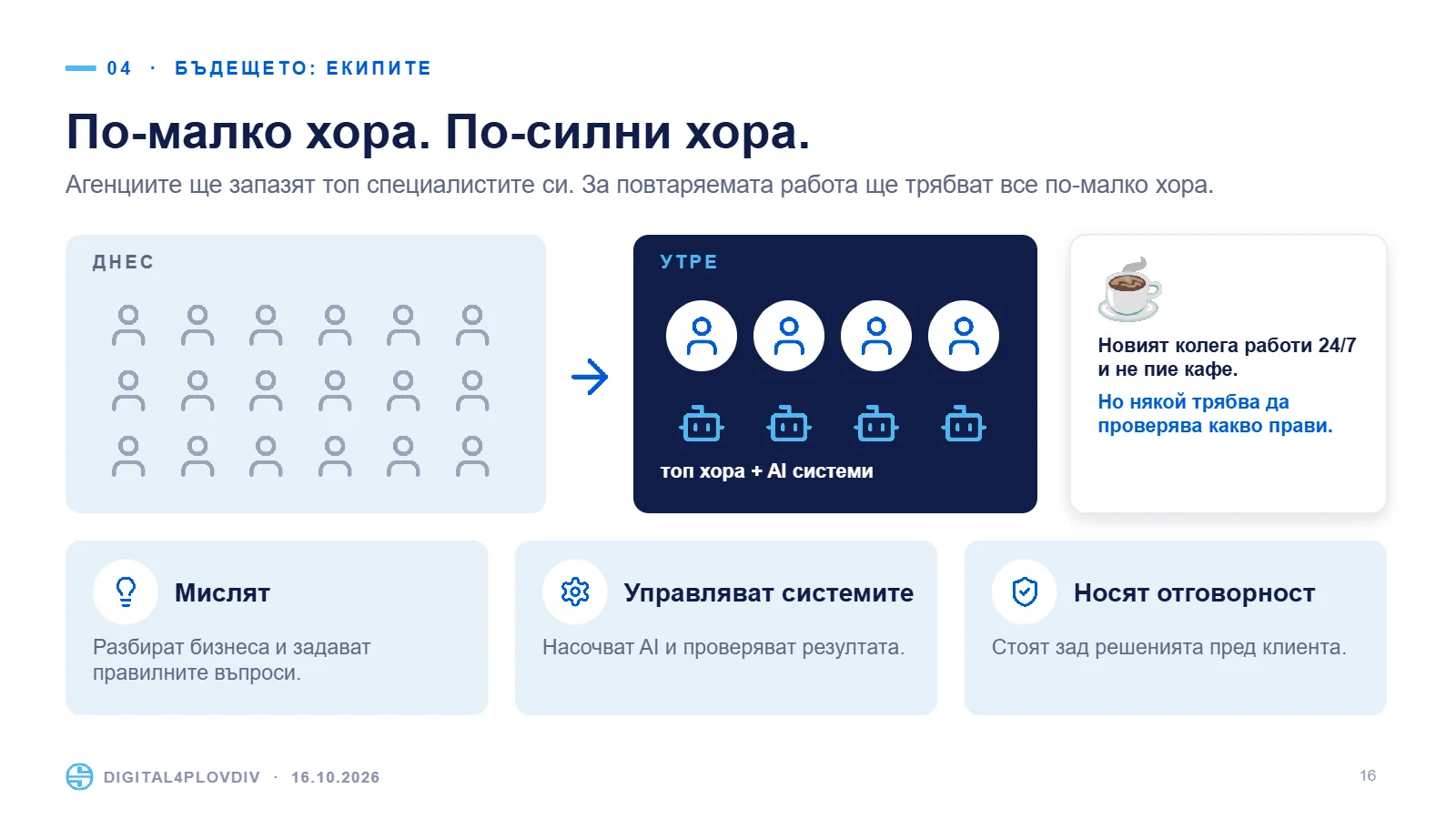
Fewer people. Stronger people.
Agencies will keep their top specialists, while fewer and fewer people will be needed for repetitive work. The role of those who stay is changing. They:
- think: they understand the business and ask the right questions;
- run the systems: they steer AI and check the output;
- take responsibility: they stand behind the decisions in front of the client.
The new colleague works 24/7 and does not drink coffee. But someone has to check what it does.
The formula of the agency of the future
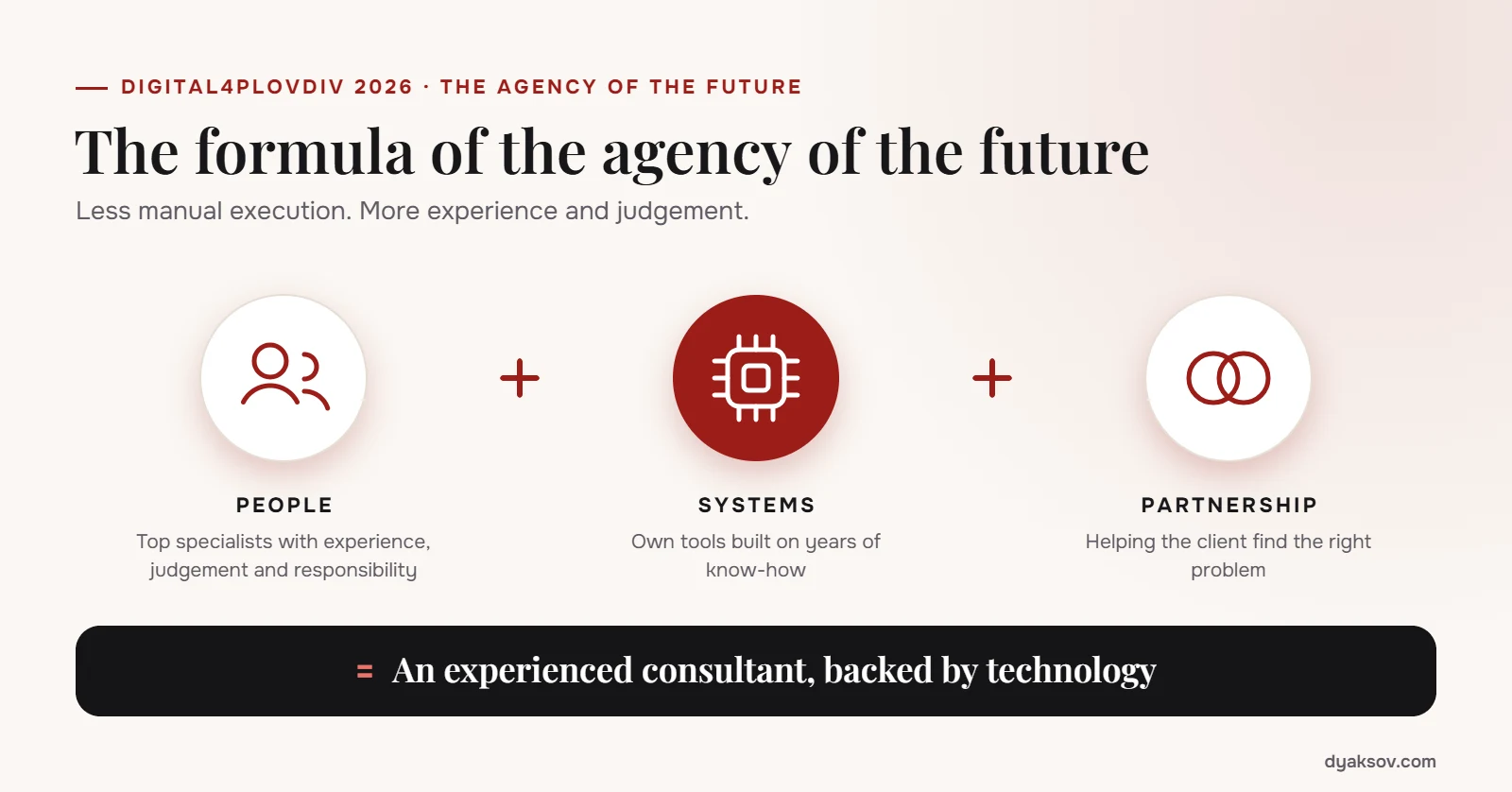
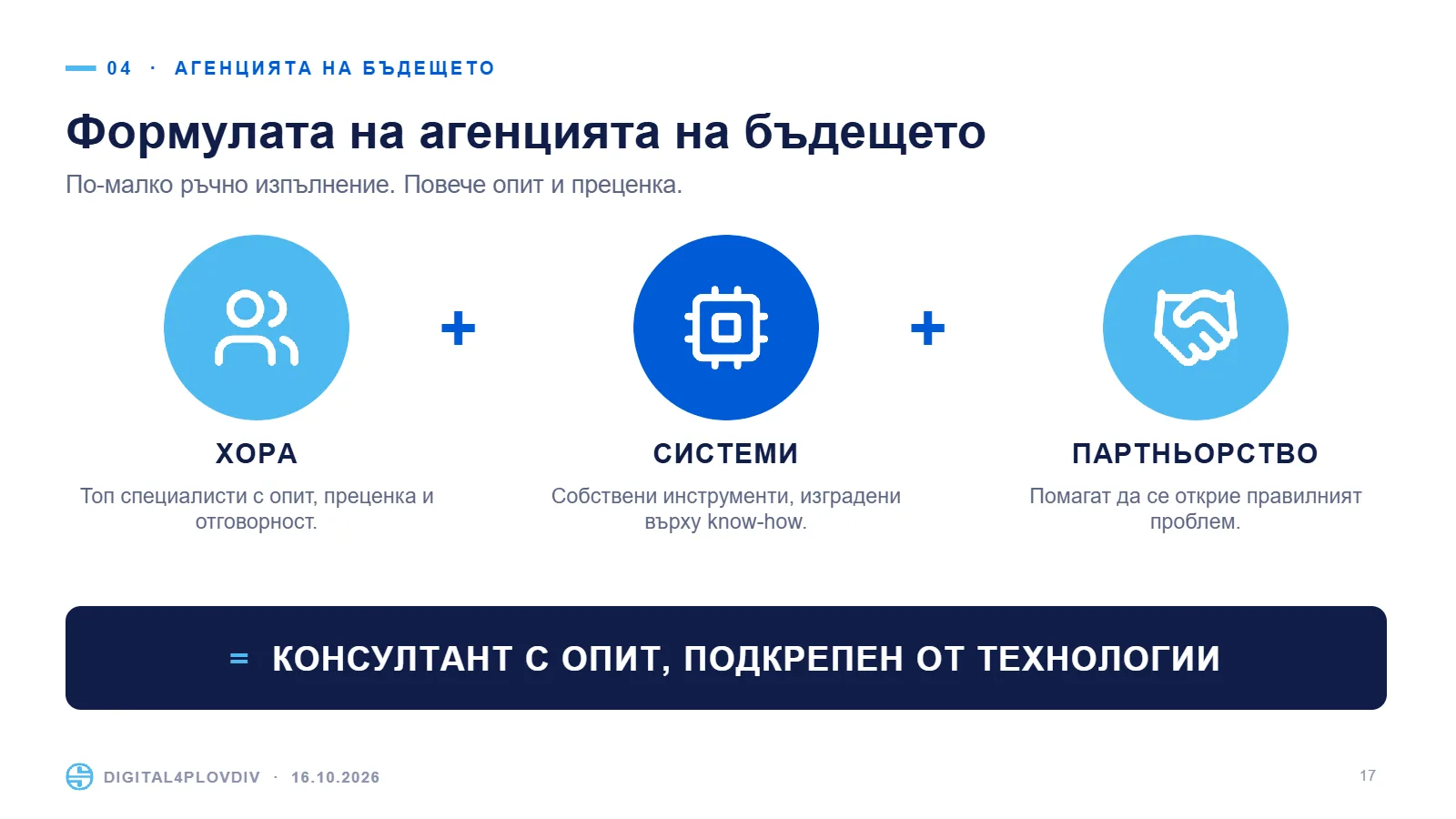
Less manual execution, more experience and judgement. The formula has three parts: people (top specialists with experience, judgement and responsibility), systems (proprietary tools built on know-how) and partnership (helping the client find the right problem). The result is an experienced consultant, backed by technology.
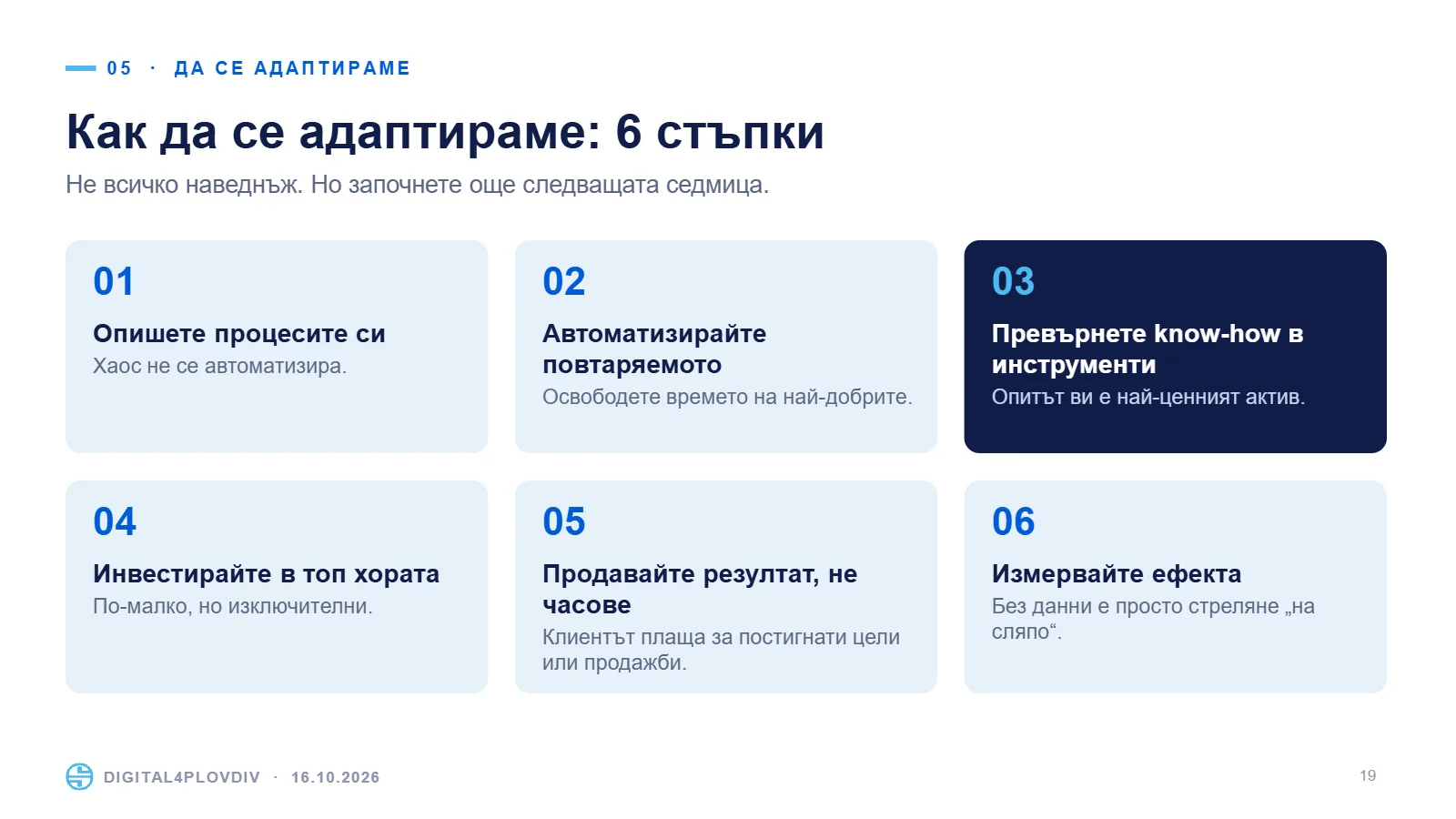
How to adapt: 6 steps
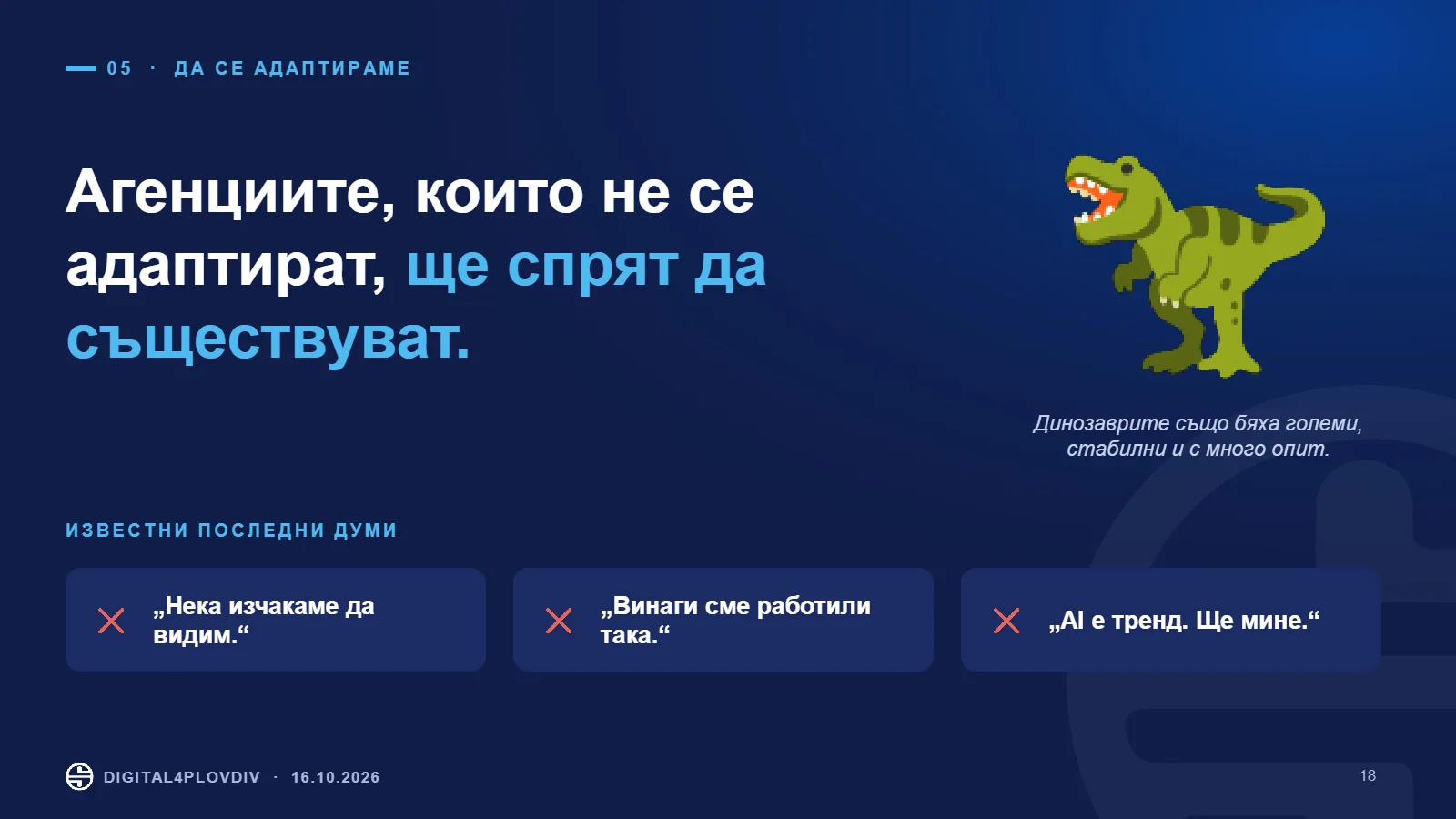
Agencies that do not adapt will cease to exist. Dinosaurs were also big, stable and very experienced. Famous last words: “Let’s wait and see.”, “We have always done it this way.” and “AI is a trend. It will pass.”
You do not have to do everything at once. But you can start as early as next week:
- Document your processes. You cannot automate chaos.
- Automate what repeats. Free up your best people’s time.
- Turn know-how into tools. Your experience is your most valuable asset.
- Invest in top people. Fewer, but exceptional.
- Sell results, not hours. The client pays for goals reached or sales made.
- Measure the effect. Without data, you are just shooting in the dark.
The takeaway
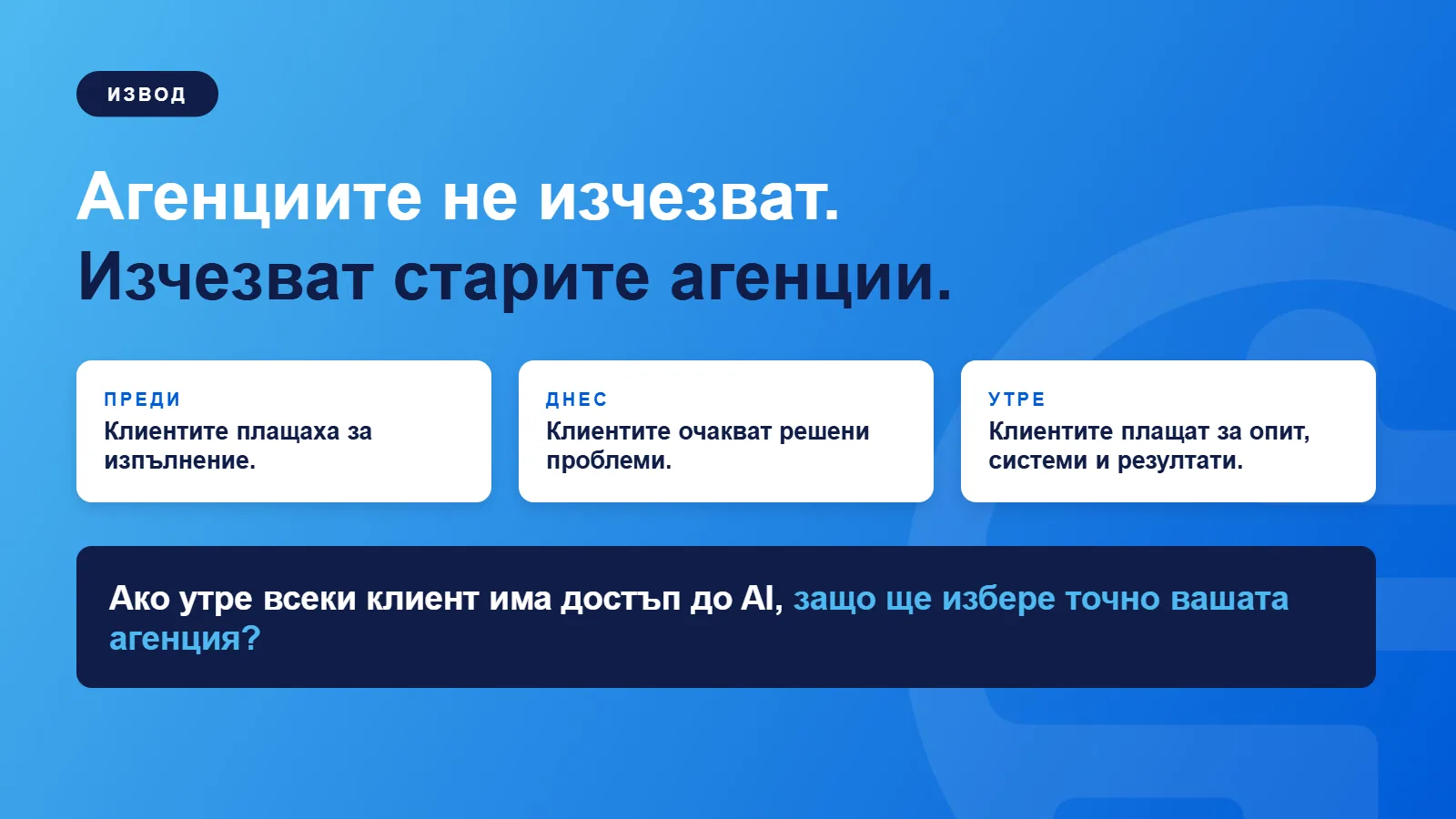
Agencies are not disappearing. Old agencies are.
In the past, clients paid for execution. Today they expect problems solved. Tomorrow they will pay for experience, systems and results. So I will leave you with the question we closed the talk with: if tomorrow every client has access to AI, why would they choose your agency?
Digital4Plovdiv was once again an excellent event, now for the tenth year in a row. Lots of great people, interesting conversations during the breaks and questions that went on long after the talk. Thank you to the organisers for the invitation and to everyone we met there!
If you would like to discuss how AI could change the way your team or agency works, get in touch.
The full presentation
Browse the slides with the arrows or by swiping, and use the full screen button to view them as they appeared on stage. The slides are in Bulgarian.



Petar Dyaksov
Entrepreneur, investor and managing partner at SEOMAX, with more than 15 years of experience in e-commerce and digital marketing. He builds businesses in technology and e-commerce, invests in companies and supports entrepreneurs. Speaker, trainer and mentor at dozens of conferences, seminars and entrepreneurship programmes.
More about me