How AI helps automate and optimize business processes

Contents · 14 sections
- What is artificial intelligence, and why should you…
- How does AI drive the automation and optimization…
- Why are businesses afraid to adopt artificial intelligence?
- What are the real benefits of using AI…
- What are the most common uses of AI…
- How do you start using AI in a…
- Which AI tools do businesses use most, and…
- How do you choose the right AI tools…
- How does AI improve data management and business…
- How is artificial intelligence changing project management and…
- What are the risks of using AI and…
- How do you measure the effectiveness of AI?
- When is the right time to scale your…
- Key takeaways:
In just a few years, artificial intelligence has become a reality that is changing how we work, communicate and grow businesses. If you’re reading this, you can probably feel the world around you shifting, and you don’t want your business left on the sidelines.
What is artificial intelligence, and why should you understand it?
Artificial intelligence is the ability of machines to simulate human thinking, behavior and analysis. When we talk about AI in business, we really mean using algorithms, AI tools and software that help organizations adapt, optimize and make better decisions based on analysis of large volumes of data.
Mastering AI doesn’t mean becoming a programmer. It means knowing how to ask the right questions, spot the right solutions and trust automation when it delivers real value. In today’s business world, using AI isn’t a luxury. It’s how you stay relevant.
How does AI drive the automation and optimization of business processes in 2025?
Optimization starts with data analysis, process automation and cutting out routine tasks. AI systems can process huge amounts of data with minimal human intervention, which leads to higher efficiency and far fewer errors.
In 2025 we’re seeing much wider adoption of these solutions across sectors, from customer service and marketing to project management, the supply chain and even HR systems. Automated chatbots, natural language processing, demand forecasting and even personalized marketing campaigns all save time and money.
Why are businesses afraid to adopt artificial intelligence?
Many organizations hesitate. They worry about losing control, about big investments or about not knowing enough. That’s a completely normal reaction. When we hear “artificial intelligence,” part of us imagines something complicated and out of reach. In reality, adoption starts with small, deliberate steps, with the courage to experiment and the vision to see the potential.
Your business is unique, and AI tools can be customized and adapted to your needs. You don’t have to replace everything. Sometimes improving a single process is enough: how you handle inquiries, for example, or how you collect and analyze customer reviews.
What are the real benefits of using AI in business?
The benefits are tangible, and they work on several levels. First, automation takes the load off your teams and lets them focus on creative and strategic work. Second, data analysis and forecasting make better, informed decisions possible. And third, personalized products and services build a stronger connection with customers.
AI offers efficiency and a competitive advantage. If, for example, you use a CRM system that analyzes customer behavior with AI models, you don’t just understand what a customer is doing. You understand what they’re likely to do next.
What are the most common uses of AI in marketing and customer service?
This is where things get really interesting. In marketing, these technologies support campaign optimization, customer behavior analysis, content personalization and even text and visual generation. You can use AI to build marketing strategies that change in real time based on the results of each campaign.
In customer service, chatbots with natural language processing answer frequently asked questions quickly and accurately, route people to the right department or even resolve issues without an employee stepping in. That improves the customer experience and keeps costs down.
How do you start using AI in a small or medium-sized business?
If you think AI is only for big players with huge budgets, let me put your mind at ease. The truth is, adoption can start with affordable tools that require minimal technical knowledge. It all depends on where you need it most.
The most common first steps include using AI platforms to automate marketing tasks, analyze customer data, optimize content and handle customer service through smart chatbots. There are tools you can connect directly to your website, CRM or email platform, with no developers needed. The most important thing is to pick the one process that matters most to your business and start there.
Which AI tools do businesses use most, and why?
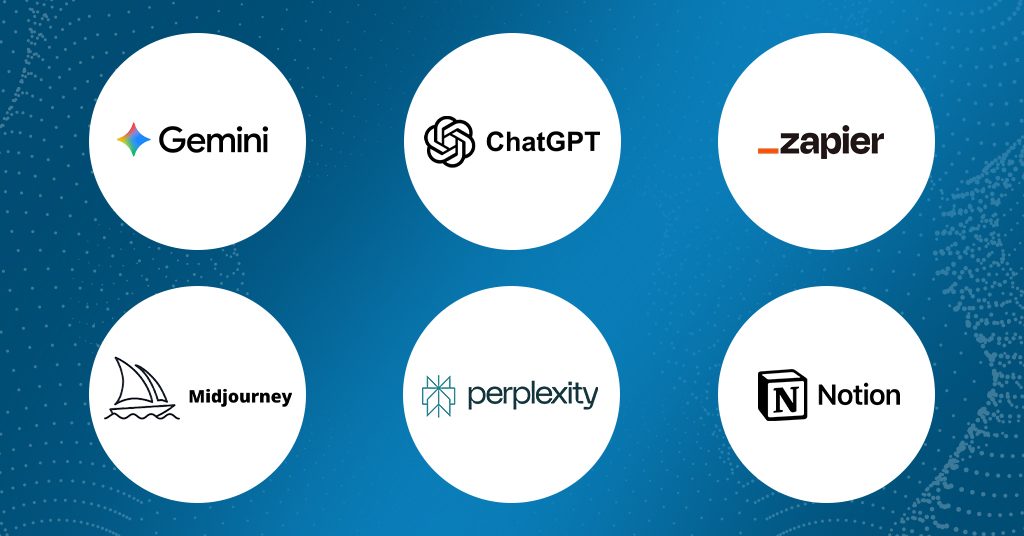
Once AI starts finding its way into your teams, the obvious question is: “So what do we actually start with?” There’s no universal answer. But a few AI tools show up almost everywhere today, from small family businesses to international companies. Here are some of them, explained in plain English, so you can see exactly what they can do for your business:
ChatGPT
ChatGPT is used for everything, from writing emails and explaining complex topics to holding conversations with customers and writing articles like this one. You can build it into a chatbot, connect it to your CRM or simply use it when you’re at a loss for words. It’s the smart assistant that always has an idea.
Perplexity
If you need information on a topic that changes every day, such as competitors, prices or trends, Perplexity is the place to go. It doesn’t just hand you links. It sums up the gist of everything it found. It’s especially useful for marketing teams, people with lots of meetings and anyone who wants to think fast without wasting time searching.
Gemini (Google)
With Gemini you can process documents, pull key information out of spreadsheets and presentations, or even create new materials from just a few words. It’s handy when there’s too little time and too much to do. It works well with everything in Google Workspace, which makes it a natural choice for many teams.
Midjourney
This one is a favorite among visual thinkers. Midjourney turns a text description into striking images for websites, ads, social media or just plain inspiration. If you’ve ever thought, “If only someone could draw this for me,” now someone can.
Zapier + AI
Zapier connects all your systems, and adding AI takes the automation even further. For example: a new customer form comes in → it’s saved to your CRM automatically → an email goes out → a task is created. All without touching your mouse. That’s automation in action.
Notion AI
If you love taking notes, organizing information or simply thinking on paper (or on screen), Notion AI will quickly become your go-to. It generates ideas, summarizes text, suggests structure and helps you think faster. It’s especially handy if you work in a team and need a place for shared knowledge.
Every tool has its purpose, and you don’t need to use all of them. Think about where you’re getting bogged down, where routine tasks pile up and which AI could take them off your plate so you have time for what matters. The question isn’t which tool is the trendiest but which one is the most useful for you.
How do you choose the right AI tools and platforms?
Choosing the right tools depends on two things: your goals and your team’s capacity. If your main goal is automating marketing campaigns, look for solutions that offer content optimization, personalized recommendations and customer data analysis. If you’re focused on customer service, look at platforms that offer natural language processing and chat integration.
Also consider how easily these solutions fit into your existing management systems, and whether they offer support, flexibility and scalability. AI solutions aren’t one-size-fits-all. They need to be adapted to the workflows of each specific business.
How does AI improve data management and business decisions?
One of AI’s greatest strengths is its ability to combine, analyze and visualize large volumes of data in ways people would struggle to match on their own. When organizations use it for data management, they start making decisions based on real, dynamic analysis.
Imagine seeing in real time which products are most in demand, which customers are about to leave or what the best price for a service is. With LLMs for forecasting and analysis, that’s already a reality. And this is where AI truly proves its worth in business: transforming the business through informed decisions and higher efficiency.
How is artificial intelligence changing project management and operations?
In traditional project management, we usually talk about planning, control and forecasting risk. Add artificial intelligence to the mix, and project management becomes predictive. AI can analyze hundreds of variables, from deadlines, resources and team workload to seasonal swings and possible delays. Forecasting systems can predict problems before they happen, which gives you time to react.
In business operations, AI automates approvals, logistics, KPI analysis and even the optimization of the entire supply chain. All of this serves one clear goal: improving operational efficiency and saving resources. This is no longer just about saving time. It’s about a successful business that can adapt in real time.
What are the risks of using AI and how do you manage them?
Let’s be honest: no technology comes without risks, and using AI is no exception. The main concerns include data protection, ethical issues and too much dependence on automated systems. That’s why, when you adopt AI, you need a clear strategy: what data you use, how it’s stored, and what mechanisms are in place for review and human intervention when needed.
Teams need training on how to use the tools and where their limits are. AI doesn’t replace human intelligence. It extends it. When technology is used responsibly, it doesn’t take control away. It gives you better control.
How do you measure the effectiveness of AI?
Before you invest in any AI technology, you need to know how you’ll measure the results. A gut feeling that “it works” isn’t enough. Measuring effectiveness takes clear KPIs set before implementation.
For example:
Shorter service times, higher conversion rates, better engagement in marketing campaigns, lower labor costs or more accurate forecasts.
The key point here is:
AI should optimize, not complicate. If your systems don’t lead to higher efficiency, better service or better decision-making, you need to fine-tune them or give your team more training. There are plenty of tools for analyzing large volumes of data that can help you evaluate results in real time.
When is the right time to scale your AI solutions?
Once you see positive results, the question becomes: “Are we ready to scale?” The time is right when:
- Your processes are already automated at a basic level;
- Your team knows how the systems work;
- You have a clear strategy and business goals;
- You see proven results from the AI models you’ve put in place.
Scaling doesn’t mean “let’s add more systems.” It means building AI into the entire structure of the business: thinking about automation not just within a single department but across the whole customer journey, from the first click to after-sales service.
Artificial intelligence won’t replace you. It will lift you higher. It will help you work smarter and faster, with more clarity and more confidence. This isn’t just about algorithms and technology. It’s about people: your teams, your customers and the future you’re building today.
Key takeaways:
- AI is a powerful tool that analyzes, forecasts and automates with minimal human intervention.
- It can be used in every area: marketing, sales, customer service, logistics, project management.
- Adopting AI doesn’t require huge budgets. There are affordable, easy-to-use tools.
- You measure effectiveness through clear KPIs and data analysis.
- Process automation leads to higher efficiency and frees up resources.
- Personalized solutions make a business more flexible and competitive.
- Data protection and human expertise remain essential when working with artificial intelligence.
- Now is the time to start: with small steps, big goals and a clear vision for the future.
Petar Dyaksov
Entrepreneur and founder of a digital agency, in e-commerce since 2009. He grows online businesses such as Fragrances.bg and Timedix and shares his experience as a speaker, moderator and mentor at nearly 80 conferences and trainings.
More about me