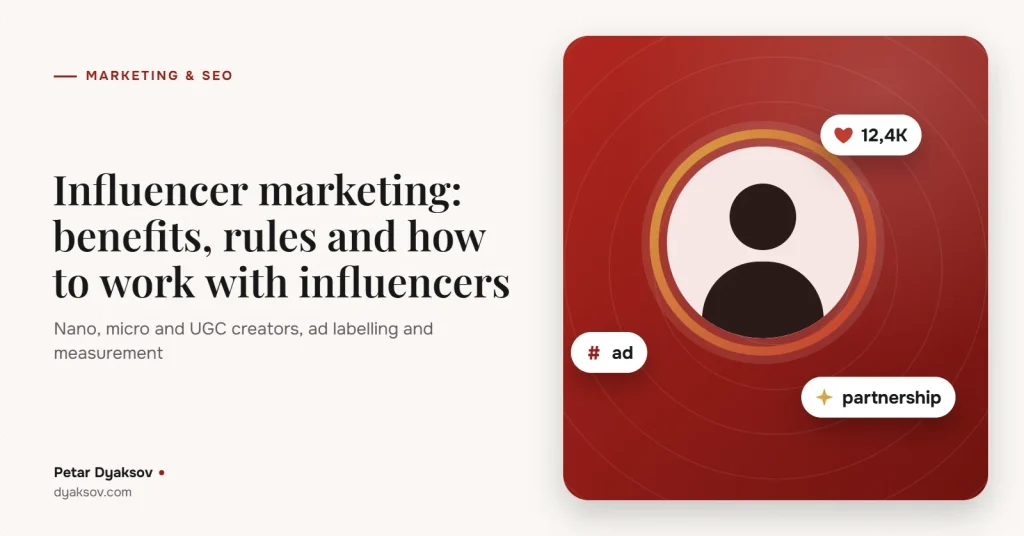
Influencer marketing: benefits, rules and how to work with influencers

Contents · 7 sections
I have been working with influencers since 2012-2013, when in Bulgaria it was simply called "working with bloggers". I wrote the first version of this article at the end of 2017. Back then we talked mainly about YouTube and blogs, while Instagram and TikTok were on the fringe or did not exist yet.
Today influencer marketing is an industry of its own with its own rules, agencies and regulation. In this updated version we look at how big the market is, which creators to choose, what the law says about labelling ads and how to approach it to get real results.
What is influencer marketing in 2025?
It is a partnership between a brand and a person who has the trust of a certain audience on social media. Instead of the company talking about itself, the product is recommended by someone people already follow and like.
In 2017 that meant bloggers and YouTubers. Today the main platforms are Instagram, TikTok and YouTube, and UGC creators play a growing role: people who film authentic product content for a brand's ads and profiles without necessarily posting it themselves.
The market in numbers
- According to Influencer Marketing Hub the global market will reach 32.55 billion dollars in 2025, up from around 24 billion in 2024 and just 1.4 billion in 2014.
- The most used platforms for campaigns are Instagram (57%), TikTok (52%) and YouTube (37%).
- 66% of marketers say AI helps them get better results, for example when choosing the right profiles.
In Bulgaria, the study "The Pulse of Influencer Marketing 2024" by MSL Sofia and Pragmatica shows that 53% of consumers trust the influencers they follow, down from 63% a year earlier. 32% regularly buy under their influence, and 88% want paid content to be clearly labelled.
Nano, micro, macro or UGC: whom to choose?
- Nano influencers (up to about 10,000 followers): a small but highly engaged audience, good for local businesses and niches.
- Micro influencers (10,000-100,000): the best balance of reach, trust and price. 75% of brands in Bulgaria work with them.
- Macro influencers and celebrities: big reach and a high price. 80% of Bulgarian brands find fees high relative to results.
- UGC creators: you are not selling to their audience but buying authentic content for your ads.
The most common complaint from brands is that the same influencers advertise everything from coffee to banking products. Choose people who really use similar products and whose audience matches your customers.
Labelling ads is mandatory
This is the biggest change since 2017. The European Commission set up the Influencer Legal Hub and made it clear that influencers who regularly post commercial content are traders under consumer law and must label advertising.
In a 2024 sweep by the Commission and national authorities, 97% of the 576 influencers checked had posted commercial content, but only about 20% consistently labelled it as advertising. 358 profiles were referred for further checks.
In Bulgaria the National Council for Self-Regulation has published recommendations for influencer marketing and on 12 February 2025 ran a training on the topic together with the media regulator. The practical rules are simple:
- use the platform's "Paid partnership" label;
- label ads clearly and upfront, not hidden among dozens of hashtags;
- label gifted products too when a post is expected in return.
How to approach an influencer
In my experience, about half of the bloggers and vloggers I contacted early on never replied. So the first message matters:
- Show you know their profile by mentioning a specific post you liked.
- Introduce the brand in one sentence and why it suits their audience.
- Suggest a concrete idea but leave creative freedom.
- Be clear about terms: fee or product, number of posts, deadlines, rights to reuse the content in your ads, and mandatory labelling.
- Put it in writing, even for a small collaboration.
What results to expect
I have seen both sides. A sponsored YouTube video with two influencers gathered more than 300,000 organic views in Bulgaria, and blog posts in exchange for gifted products brought dozens of sales. I have also seen campaigns that brought likes and nothing more.
According to the Bulgarian study, the strongest purchase drivers are a product review or demo (59%) and a promo code (48%). So:
- give each influencer a unique promo code and a UTM-tagged link;
- track clicks, sales and new followers, not just reach;
- reuse the best content in your paid ads, for example through partnership ads on Instagram.
Virtual influencers and AI
Virtual influencers created entirely with AI are appearing more often. They are predictable and never get tired, but half of Bulgarian consumers have already seen such content and 29% say they would unfollow because of it. Use them carefully and transparently. In influencer marketing the most valuable asset is trust, and trust comes from real people.
Petar Dyaksov
Entrepreneur, investor and managing partner at SEOMAX, with more than 15 years of experience in e-commerce and digital marketing. He builds businesses in technology and e-commerce, invests in companies and supports entrepreneurs. Speaker, trainer and mentor at dozens of conferences, seminars and entrepreneurship programmes.
More about me