E-commerce 4x4: running a successful online store in Bulgaria

Contents · 4 sections
How to grow your online store’s sales
E-commerce has been growing at an impressive pace in recent years. The latest Eurostat data shows that 44% of Bulgarians with internet access also use it to shop. So it’s no surprise that online sales to consumers in Bulgaria hit a record last year. Turnover for 2022 reached €1.64 billion, and industry forecasts expect e-commerce to make up a quarter of all retail sales within the next two years.
More and more businesses are getting into online retail. But once they launch their new store, many discover that making it work takes a good marketing strategy, one that fits their business, their industry and their niche.
If you’ve reached the same conclusion, this article is for you. We’ll cover the essentials of four core elements of any digital marketing mix: performance marketing, social media marketing, search engine optimization and content. You’ll learn what each one is, why it matters and how to use it to grow your online sales.
This article sums up the training “Ecommerce 4x4: Successful Online Retail in Bulgaria,” held by SoftUni (Software University, a leading Bulgarian tech education provider) on October 4, 2022. You’ll find more details and useful information in the full video recording of the seminar (in Bulgarian) and in the accompanying presentation.
Performance marketing
What is it?
Performance marketing is a branch of digital marketing where every campaign aims for a specific result: users taking a certain desired action (a click, a sale or a newsletter signup, for example). Hence the name: you pay for performance.
What makes performance marketing work?
Performance marketing covers a wide range of ad types, platforms, goals and tactics. What they all have in common is that you can track the results of every campaign precisely. The most successful performance campaigns come from knowing the business model and the audience well, running the right tests and budgeting smartly. This is where KPIs, or key performance indicators, come in.
KPIs
KPIs are the core metrics you track to judge whether your campaign results are good and when it’s time to make changes. They’re the information behind the big decisions about your campaigns and your business.
What counts as a “good” KPI value differs from company to company and depends on a number of factors. To set effective KPI targets, you first need to answer seven important questions:
- What is the final price of your product?
- What is its cost of goods?
- What is your average order value?
- What is your average advertising cost?
- What percentage are your overhead costs? (accounting, warehouse rent and so on)
- What is your shipping cost?
- What is your return rate?
Everything about growing your business rests on these questions. You can use them both to plan and test a business idea up front and to grow an existing business. The answers will help you set financial goals, work out the minimum daily (or monthly) ad budget you need, and more.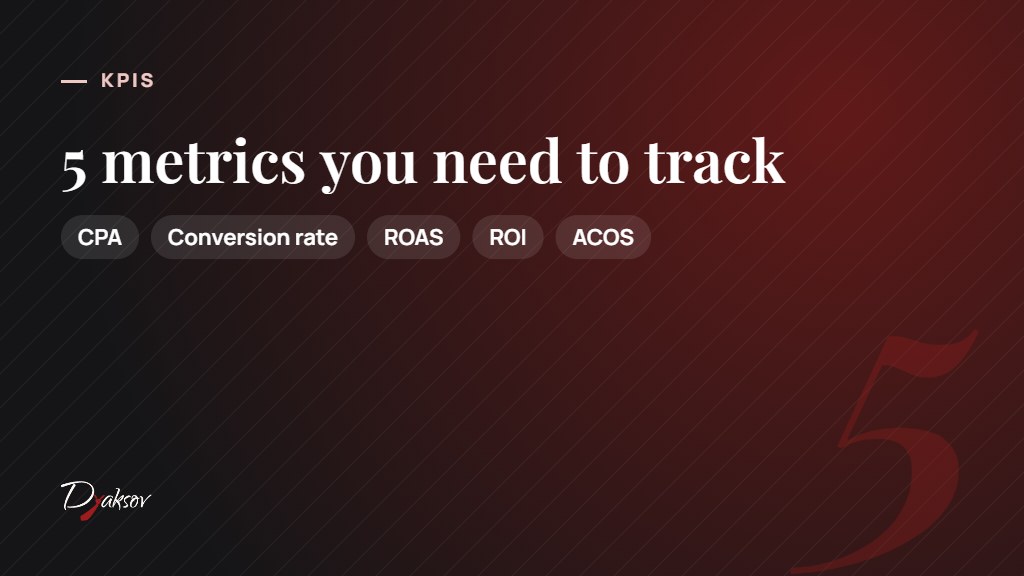
There are five key performance indicators you absolutely need to track:
- CPA (cost per acquisition): what it costs to get a user to take a certain action. In other words, the ad spend it takes for one user to click your link, sign up for your newsletter, add a product to the cart, complete an order and so on.
- Conversion rate: the percentage of all your site’s visitors who took the action you wanted.
- ROAS (return on ad spend): the revenue from a given ad channel divided by your ad spend on that channel.
- ROI (return on investment): profit (gross or net) divided by the ad budget. It tells you the real return on every lev (the Bulgarian currency) you invest in advertising.
- ACOS (advertising cost of sales): the percentage of your revenue that goes to advertising.
Facebook ads
Facebook is one of the most popular platforms for performance marketing. Lately you often hear that it’s past its prime. And while younger audiences do prefer networks like Instagram or TikTok, the numbers show that about 4.5 million Bulgarians of all ages use Facebook.
For more than 15 years, Facebook has let businesses show relevant ads to users through precise targeting. Today the platform offers many ad formats and placements. In our experience, some of the most effective right now are carousels, dynamic catalog ads, single image ads, instant experience ads and video ads.
One important thing to remember on this platform: don’t change your campaigns too often. After every change, give it at least a week before you judge the result. Just as important, make one change at a time. That way you’ll get valuable, detailed information about your audience and what it responds to. Little by little, you’ll learn what works best for your business and audience, and over time you’ll get the most out of your results.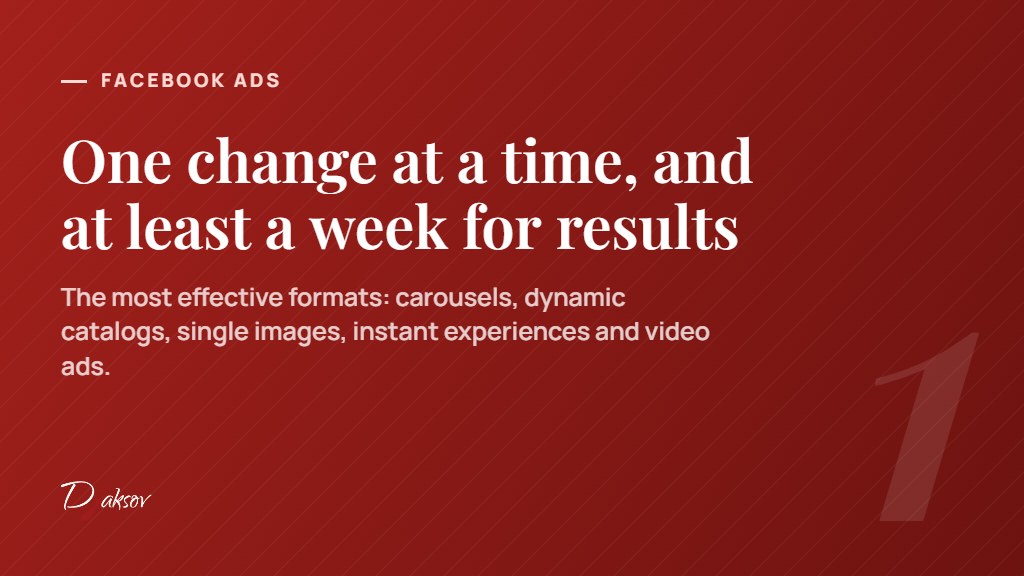
In the full video training, you’ll find two strategies for structuring Facebook campaigns that have worked well for many of our clients and that you can test for your business. You’ll see how to structure your lookalike and remarketing audiences, and you’ll get extra tips and tricks for optimizing your Facebook campaigns to make the most of your budget.
Google Ads
Google’s ad platform is the other giant in the market, which will surprise no one. The power of Google ads comes not only from Google’s 91.1% global market share (and around 95 to 96% in Bulgaria) but also from the chance to put your company in front of the right audience at a specific stage of the customer funnel. That makes Google ads a practically mandatory part of every online store’s marketing mix.
Interestingly, you don’t need to advertise on a huge list of keywords to succeed with Google ads. The right number depends entirely on your budget. As with Facebook, it’s important to start with a series of experiments to settle the optimization type, the audiences and other key details. That’s how you’ll find out which combination of settings delivers the best results for your business.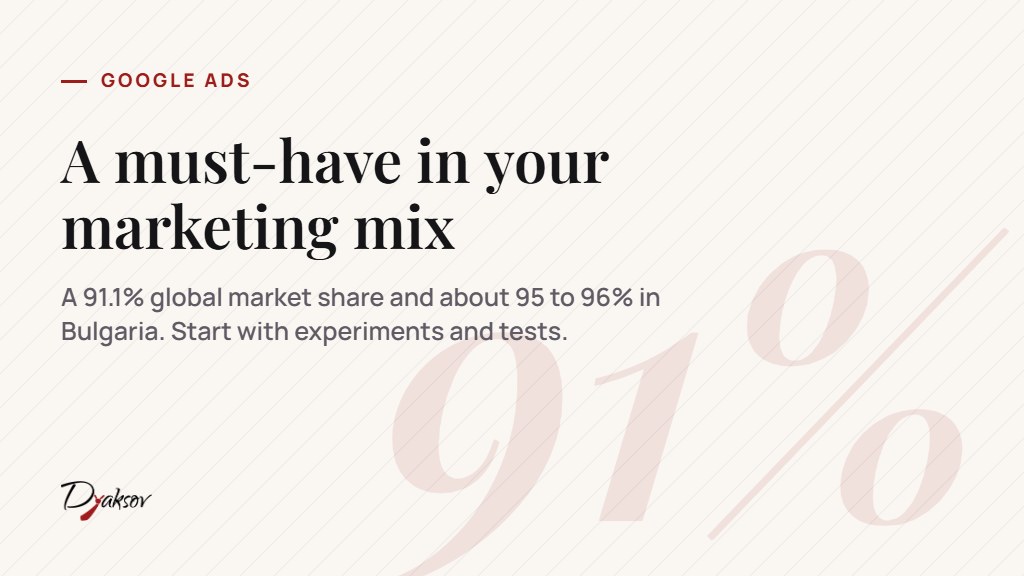
For example, if you use Dynamic Search Ads, it’s a good idea to test broad audience targeting (the Observation/Targeting settings) for at least 30 days. This will show you the different interests that lead people to convert. Once you have that information, you can use it for more specific targeting.
Performance Max is another campaign type worth testing. Google is putting a huge emphasis on these campaigns right now, and they can deliver excellent results. If you don’t have a video, you can make one with the platform’s built-in tool, a few photos and a little text.
When it comes to Google Ads, we have to mention Quality Score. It’s a diagnostic tool that shows how your ad stacks up against your competitors’ ads. Google’s recommendations for improving your ads, however, cut both ways. Google gives you plenty of them, but very often they won’t be right for your brand. One common suggestion, for example, is to use broad match keywords. In our experience, that only makes sense when the keyword you want has very limited monthly search volume.
That’s why campaigns with a good optimization score often earn a much better return than campaigns with an excellent one. When you decide a recommendation isn’t relevant to you, you can dismiss it. You can also mark it as already applied. That raises your campaign’s optimization score even if you haven’t implemented every recommendation. It’s important to keep this score above 90%.
Social media marketing
What is it?
Unlike paid advertising, social media marketing relies on reaching users organically. In the early days of social networks, this worked beautifully, and it helped many resourceful businesses reach huge audiences with a big dose of creativity.
Lately, though (with the exception of some newer platforms like TikTok), organic reach has gotten harder and harder. That’s why social media marketing shouldn’t be your only channel for promoting an online store. It can, however, be an excellent addition to a well-rounded marketing strategy.
What content gets results?
If you want good organic reach, your content has to be fun, interesting and engaging. But as we mentioned, even great posts rarely get results without paid promotion.
One tactic that has been working better and better for building awareness (and, in turn, boosting sales) is partnering with the right influencers.
When should social media be a priority?
This type of marketing isn’t enough on its own to promote an online store, but if you have your own brand, you absolutely have to make it a priority. In that case, it makes sense to invest serious time, effort and money in social media content. The goal is to make your brand recognizable, build trust with your audience and become a brand customers know they can rely on.
If you have your own brand but also sell other brands, you don’t need to put in quite as much effort. You can focus on one or two social channels.
If your online store only sells other companies’ products, social media marketing can play a purely supporting role. Your top priority should be securing a big enough budget to advertise your store.
Although Facebook is gradually losing ground worldwide to newer networks aimed at younger audiences, it’s still very strong in Bulgaria, especially among working-age people, a good audience with real purchasing power. The downside is that it’s getting harder and harder to reach even the people who have actively liked your page.
Fun posts work well on Facebook. But your tone on this network needs to match both your brand and your audience. If your core audience is more mature, for example, informative or useful posts may suit your brand better. They can relate to your products or your niche and keep your audience informed on topics that matter to you.
Whatever strategy you choose, illustrate your posts with good visuals that are fully in line with your brand and its visual identity. If you don’t have graphic design experience, it’s better to hand social media design to a professional or a graphic design service.
Giveaways and contests have traditionally done very well on Facebook. But you should know that while almost every company makes liking the page a condition of entry, this actually goes against the platform’s policies.
Video is gaining momentum on every platform, Facebook included. Here, the key is short clips. If there’s speech, always add subtitles, because a huge share of users scroll with the sound off. Reels also have strong potential, and few businesses use them, which makes them a great way to reach a bigger audience organically. Stories deserve a mention too. They’re an important part of a Facebook content strategy that you shouldn’t ignore.
In e-commerce, product reviews and customer opinions matter enormously, both for a brand’s reputation and for the decision to buy. Encourage your audience to post them, along with user-generated content (unboxing videos, for example). All of this builds trust in your brand without much effort on your part.
What sets Instagram apart is that its audience is made up mostly of young millennial professionals. Visuals are front and center here, although the platform also lets you write fairly long captions. One important detail: you can’t put links in post captions. Links are only allowed in your profile bio.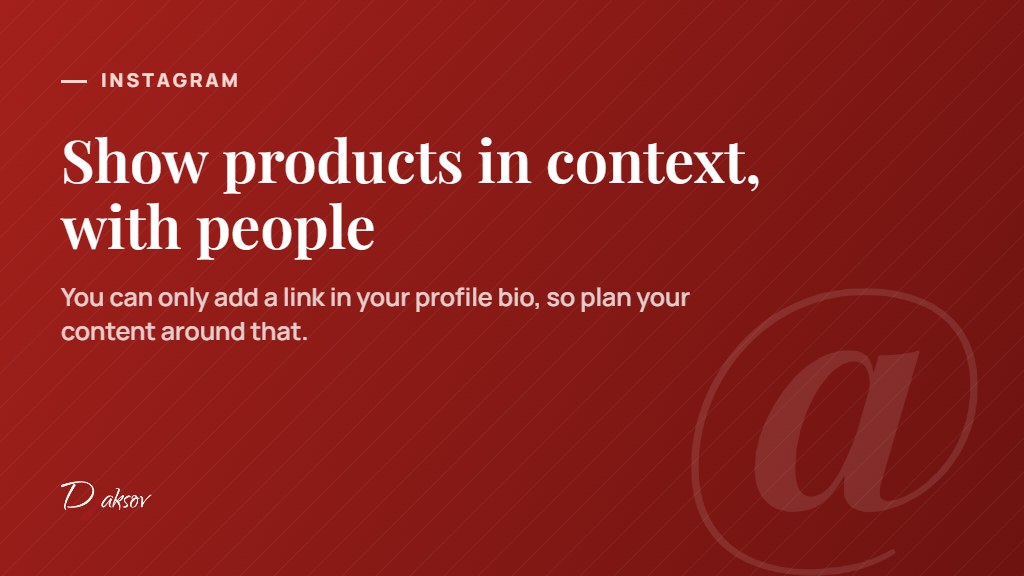
There are lots of options for Instagram content. Part of it can be dedicated to your products, for example. Ideally, your images should feature people and convey emotion. On Instagram, good styling and filters that make your visuals more interesting are fitting and even recommended. Stories and Reels are once again the formats to watch. When you prepare your posts, don’t forget relevant hashtags and emoji in the captions. They’re part of how people communicate on Instagram, so keep them in mind.
As you probably know, Instagram (like Facebook) is now owned by Meta. That makes it extremely easy to publish the same content on both networks at once. But if you have the resources, it’s better to have a separate Instagram strategy with completely original content tailored to the platform.
TikTok
Launched in China in 2016, this platform has been a runaway success, especially with younger audiences, and the trend is expected to continue in the coming years. Its format is distinctive: short, highly engaging videos. TikTok content is generally expected to entertain, although there are successful “serious” TikTok channels too.
Only a handful of businesses in Bulgaria invest in building their own channel here, and that’s exactly where the opportunity lies. Note that ads are not yet available in Bulgaria. In other countries, though, they’re already a reality, and paid advertising on the youngest social network is expected to reach Bulgaria very soon.
YouTube
Following the trend toward short videos, YouTube now offers that option too. Even so, it remains the home of long-form video. It’s especially well suited to brands where tutorials or other how-to videos make sense.
This channel is a particularly good fit if your company can produce content in-house. It can bring big benefits for your business and products and even lead to direct sales. Focus on useful content that educates your potential (and current) customers.
SEO for online stores
Search engine optimization is how we bring more organic traffic to a website. It takes effort and time to pay off. That’s why SEO only makes sense if your project is long-term and your store sells products with steady demand. If your products are more of a passing trend, there’s no point in focusing on SEO. You’re better off putting that budget into performance marketing.
The main areas of SEO
To decide how relevant a website is to a given search query, search engines look at three main types of criteria:
- how the website works;
- how it interacts with other websites; and
- the content on it.
That’s where the three main areas of SEO come from: on-page optimization, off-page optimization and content optimization. By the way, when we say “search engines,” we mostly mean Google, since about 95% of users in Bulgaria use it.
On-page optimization
The first area of SEO is about improving a website’s technical parameters: its URL structure, the internal links between pages, page meta titles (and descriptions), and factors like load speed. On-page optimization takes some technical knowledge. If you don’t have it, bring in a specialist.
Still, on-page optimization is something site owners control directly. That’s why it’s often one of the first and easiest steps toward better rankings.
Keep in mind that, depending on the infrastructure your store runs on, you may have more or less control. You have the most room to optimize with a custom system or an open-source platform, where you can even optimize the site’s code. SaaS solutions limit you to some extent. Either way, though, there’s plenty you can do.
If you haven’t built your store yet, plan its structure in advance: how your products will be grouped into categories and subcategories. That decision will largely shape the site’s URL structure, so it matters a lot. You can change the structure later, but doing so can hurt your SEO and cause a significant drop in organic traffic.
The second key part of this area is metadata (titles and descriptions): short texts that describe your pages and contain relevant keywords. Metadata helps search engines understand your content. When it’s well written, it also influences whether potential customers click through to your site and look around.
In e-commerce, we also have to mention “crawl budget.” This is the maximum number of pages Google crawls on a given site. If your store is small, you don’t need to worry about it. But if your online store has more than 5,000 products, it’s a good idea to plan how to steer search engine bots toward the most important ones.
Internal linking is one way to do that. It simply means your pages link to each other. Main categories, for example, should link to subcategories, brand pages or specific products. If you have a blog, your articles should also link to the products and categories you write about. This is one of the signals Google uses to understand which pages matter most to you.
Hosting plays a role in SEO too. First, it affects load speed. If your hosting isn’t good enough and the site often goes down or fails to load, Google takes it as a sign that the site isn’t reliable, and the site drops in the results. Other key elements of on-page optimization include Core Web Vitals and other page experience signals: criteria covering load speed, mobile usability and more. Various online tools let you track them and show you whether anything needs improving.
Another important decision is what to do with pages for out-of-stock products. This is often a tricky one. On the one hand, users don’t like landing on a page for a product that’s sold out. On the other, these pages are often already well indexed and can bring in quality organic traffic. There are different strategies for striking the right balance, and you can learn about them in the full training video (linked at the beginning of this article).
Off-page optimization
The second area of SEO happens outside your website. It’s about building external links to your site through promotion in local and national online media and websites. Links from authoritative sites confirm to Google that your website really is good. Today there’s no doubt that the quality of those links matters most. Quantity plays a far smaller role than it did years ago.
To get these links, you can fairly easily arrange with media outlets or niche sites to publish paid articles that link to your website. A nice bonus of links on niche sites is that they can also send you more quality traffic. Other link-building options include the websites of distributors, partners, associations, industry organizations, forums and so on. Catalogs and directories used to be very popular, but today they don’t bring much value, so they’re usually not worth much of your time.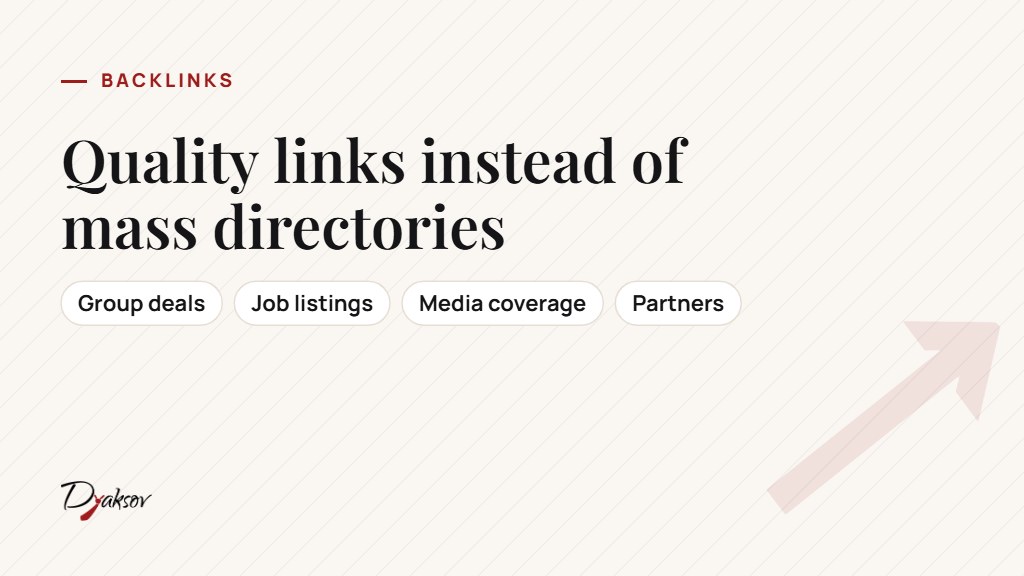
Other link-building opportunities include posting offers on group-buying deal sites, listing open positions on job boards, and entering competitions and awards. You may be wondering whether links on social media help. They do play a modest positive role in a link-building strategy, but they don’t carry as much weight as links from regular websites.
There are a few important things to keep in mind when building links. First, aim for relevant links on sites that are as authoritative as possible. Second, check whether the link is “do-follow” or “no-follow.” This tells Google whether the site vouches for the link. “No-follow” links carry less value.
Anchor text (the words a link uses) matters a great deal too. It should be varied and relevant to your business: keywords, your brand name and generic phrases like “read more” or “see here.” Lots of identical anchor texts could get you a Google penalty.
When you promote your website, consistency is key. A small number of links earned regularly works much better than a big batch all at once. This is where planning and strategy come in.
Finally, remember that a link is only as good as the site it’s on. That’s why you need to vet the sources of your links. Is the site active? Is it maintained? Is it trustworthy? Competitors might, for example, post links to your site on low-quality sites to hurt your rankings. If that happens, you can tell Google to disregard them. On the flip side, if you land a valuable link, say from a national media outlet, you can boost its authority further by building links to that page too. This is known as a “tier 2” link-building strategy.
Content for online stores
The third area of SEO is again one you control directly, because it deals with the content on your website. By “content” I mean every format: text, images, video, audio, even attached documents. Content optimization works in two directions. On one hand, it makes your content understandable to search engines. On the other, your content has to appeal to users and engage them enough to keep them on your site as long as possible.
Ideally, all of your content should be original (not copied from elsewhere). If you run a large online store, that can feel daunting or even impossible. In that case, make a plan that prioritizes pages by importance: first the main pages (the home page, “About us,” “Contact” and so on), then the category pages, and finally the product pages.
As we’ve mentioned, online stores have many types of content (product descriptions, articles, photos, documents, infographics, guides and more). And while every element of your site should be high quality, your top priority should be excellent images. If they’re attractive and well optimized, they can bring extra traffic to your site (through image search) and will probably help increase sales too.
A blog is always a bonus for an online store, because it can bring additional relevant traffic, build authority and help users. But if you decide to have one, you need the resources to maintain it and publish fresh content fairly regularly. With a good content strategy, you can achieve excellent results.
When it comes to content, keep in mind what Google calls “E-A-T”: expertise, authoritativeness and trustworthiness. In other words, well-written, well-formatted, easy-to-read articles will not only win users’ attention but also give you an edge with search engines.
Every online business is unique and has different needs. Without a doubt, success comes from hard work and consistent effort in developing and promoting your brand. With the right strategy, any online store can achieve great results. And the best news is that it can happen quite quickly.
Petar Dyaksov
Entrepreneur and founder of a digital agency, in e-commerce since 2009. He grows online businesses such as Fragrances.bg and Timedix and shares his experience as a speaker, moderator and mentor at nearly 80 conferences and trainings.
More about me