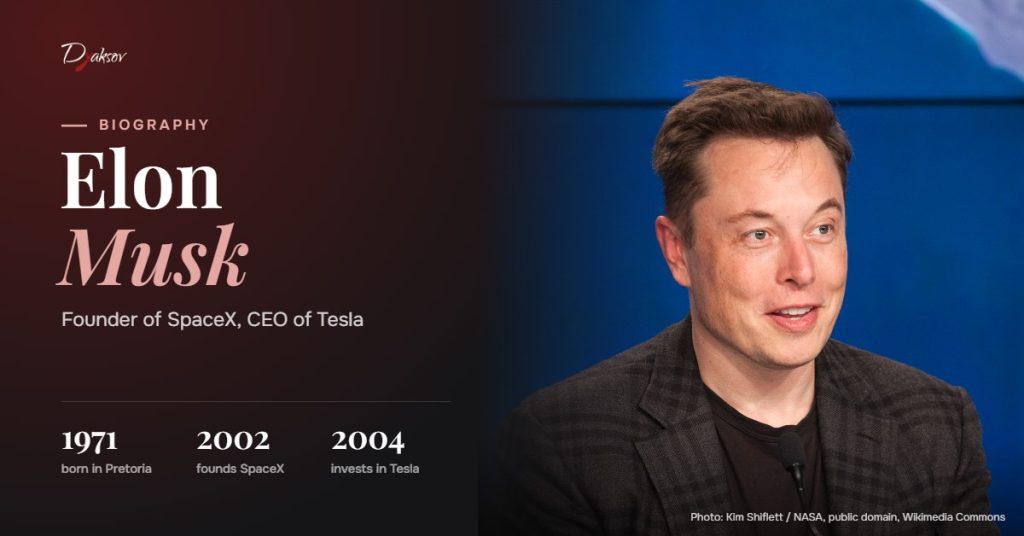
Elon Musk: a biography
Contents · 14 sections
- Elon Musk: a biography
- Childhood and early years
- The road to North America
- University and first steps in business
- The first big success: Zip2
- Reinventing online payments: X.com and PayPal
- SpaceX: reaching for the stars
- Tesla: electrifying the auto industry
- Neuralink: connecting brains and computers
- Awards and honors
- The Boring Company: rethinking city transportation
- Twitter: a new chapter in social media
- Personal life and public image
- A vision for the future
Elon Musk: a biography
In a time of rapid technological change and global challenges, one man stands out for his relentless drive to transform the world: Elon Musk. Born in Pretoria, South Africa, in 1971, Musk grew up with an unusual pairing of parents: a mother who modeled and a father who was an engineer. That mix may help explain how he combines big-picture vision with a practical, hands-on approach to solving problems.
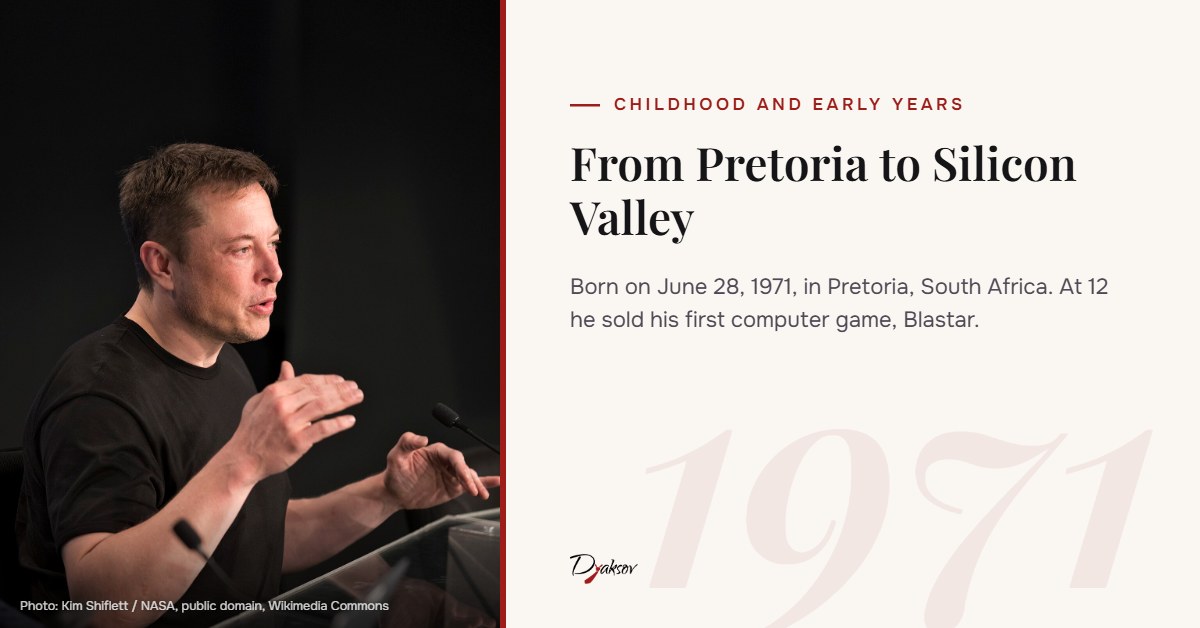
Childhood and early years
Young Elon grew up during the turbulent years of apartheid in South Africa. Instead of getting swept up in the tension around him, he buried himself in books and technology. Even as a child, he could focus intensely on whatever caught his interest, often losing track of time while reading or tinkering with electronics.
His school years were full of contradictions. He showed exceptional talent in some areas, yet his classmates often bullied him. Painful as it was, that experience helped shape his determination and his drive to succeed.
At 12, he created his first software product, a computer game called Blastar. He sold the code for $500, and his entrepreneurial career was underway. That early win gave him confidence that he could turn his ideas into reality.
The road to North America
Seeing how limited his opportunities were in South Africa, and wanting to avoid compulsory military service, Musk made a bold decision at 17: he would move to Canada. Thanks to his mother’s Canadian citizenship, he was able to leave the world he knew behind and start a new adventure.
In Canada, he took a series of low-skilled jobs, including cleaning out a boiler room at a lumber mill. Those jobs taught him lessons about hard work and endurance that would later prove priceless in business.
University and first steps in business
After a short stint at Queen’s University in Ontario, Musk transferred to the University of Pennsylvania. There he earned bachelor’s degrees in physics and economics, an unusual combination that reflects his interest in both fundamental science and the practical side of business.
Next, he was accepted into the PhD program in applied physics at Stanford University. He left after just two days, realizing that his passion wasn’t academic research but building companies that could change the world.
The first big success: Zip2
In 1995, Musk and his brother Kimbal founded Zip2, a company that provided online city guides to newspapers. In the early days of the internet, the service was extremely valuable to traditional media outlets struggling to adapt to the digital age.
Musk worked nonstop, often sleeping at the office and living on hot dogs and oranges, and he turned Zip2 into a successful business. In 1999, Compaq bought the company for about $307 million, giving Musk his first big payday.
Reinventing online payments: X.com and PayPal
Instead of slowing down after the Zip2 sale, Musk jumped straight into a new project. He founded X.com, one of the world’s first online banks. His vision was a complete financial service on the internet, covering banking, investing and payments.
X.com soon merged with Confinity, a company developing a payment system called PayPal. The merged company went all in on PayPal and turned it into the dominant online payment platform.
In 2002, eBay acquired PayPal for $1.5 billion. The deal cemented Musk’s reputation as a tech visionary and gave him serious capital for his next ventures.
SpaceX: reaching for the stars
After PayPal, Musk turned to one of his longtime passions: space exploration. Frustrated by the high cost of spaceflight and the lack of ambitious plans to explore Mars, he decided to start his own space company.
That’s how SpaceX was born in 2002, with the bold goal of making space travel more affordable and, eventually, making it possible to colonize Mars. Many people thought the idea was unrealistic, but Musk poured a huge share of his personal fortune into it.
SpaceX’s early years were full of setbacks. Three Falcon 1 launches in a row failed, pushing the company to the brink of bankruptcy. Still, Musk kept believing. The fourth attempt, in 2008, succeeded, making Falcon 1 the first privately funded rocket to reach orbit.
Since then, SpaceX has reached a series of historic milestones:
- The first private company to send a spacecraft to the International Space Station (2012)
- The first successful vertical landing of an orbital rocket stage (2015)
- The first reuse of an orbital rocket (2017)
- The first private company to send astronauts to the ISS (2020)
These achievements transformed the space industry and reignited public interest in space exploration. Musk still insists that SpaceX’s ultimate goal is to colonize Mars, which he sees as the key to humanity’s long-term survival.
Tesla: electrifying the auto industry
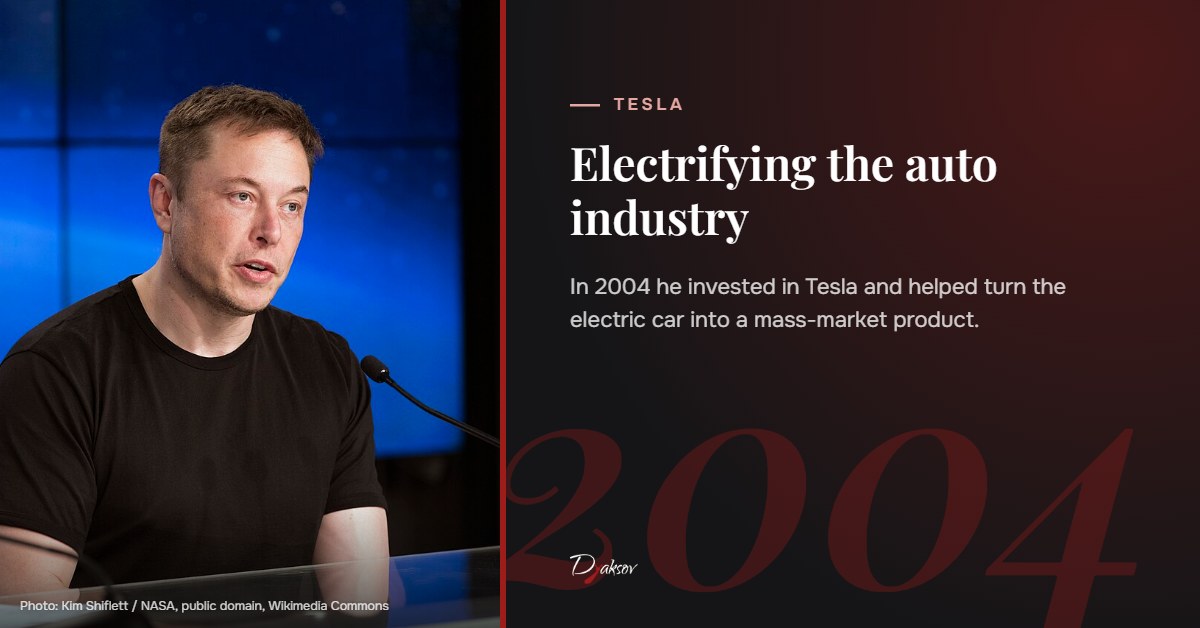
While building SpaceX, Musk took on another ambitious project: a mass-market electric car. In 2004, he invested in a small startup called Tesla Motors and soon took an active role in running it.
Tesla’s first move was a luxury sports car, built to prove that electric vehicles could be clean, attractive and fast. The result was the Tesla Roadster, introduced in 2008, which changed how people saw electric cars.
Then came the Model S, the Model X and finally the more affordable Model 3, which made Tesla a mass-market carmaker. Beyond the cars, the company has built a whole ecosystem around electric mobility, including charging stations, home batteries and solar roofs.
Musk runs Tesla in an unconventional way. He takes big risks, sets ambitious (some would say unrealistic) goals and doesn’t hesitate to clash with regulators and critics. Even so, Tesla became the most valuable car company in the world, overtaking giants with decades of history.
Neuralink: connecting brains and computers
Always looking for the next challenge, Musk founded Neuralink in 2016 to develop brain-computer interfaces. The goal is technology that lets the human brain communicate directly with computers.
Musk sees Neuralink as a potential medical breakthrough that could help people with neurological conditions regain movement and sensation. Further out, he talks about “merging” human intelligence with artificial intelligence, which he sees as a way for humanity to stay relevant in the age of superintelligent machines.
The project is extremely ambitious and faces serious technical and ethical hurdles. Even so, Neuralink has already shown early prototypes and run experiments on animals that hint at what the technology can do.
Awards and honors
Musk has received a number of awards and honors for his work in entrepreneurship, science and space technology. Some of the best known include:
- The Heinlein Prize for Advances in Space Commercialization (2011): this prestigious award recognized his work on space technology and his contribution to the commercialization of space.
- The Royal Aeronautical Society Gold Medal (2012): the society awarded Musk this medal for his outstanding achievements in aviation and the space industry.
- Fellowship of the Royal Society (2018): Musk was elected a Fellow of the Royal Society, the UK’s national academy of sciences, in recognition of his contribution to engineering and space technology.
These are just some of the honors Musk has received over the years for his exceptional contribution to entrepreneurship, science and space technology.
The Boring Company: rethinking city transportation
In 2016, fed up with traffic jams in Los Angeles, Musk founded The Boring Company. Its goal is to transform urban transportation with a network of underground tunnels.
The project met with some skepticism at first but quickly picked up speed. The Boring Company is developing new techniques for digging tunnels quickly and cheaply, along with the idea of high-speed electric shuttles running through them.
The first test tunnel opened in 2018 in Hawthorne, California, and in 2021 the company completed its first commercial system in Las Vegas. The project is still in its early days, but it shows real potential to ease traffic problems in cities.
Twitter: a new chapter in social media
In 2022, Musk made what may be his most controversial move yet: he bought Twitter for $44 billion. The deal set off an intense debate about the future of free speech online and the role of social media in society.
Musk said he wanted to turn Twitter into a “free speech” platform, a stance that has drawn both support and sharp criticism. His changes, including restructuring the company and rewriting its content moderation policies, are still hotly debated.
Personal life and public image
Musk’s personal life is as complicated and eventful as his career. He has several children from different relationships, including twins and triplets. His unconventional approach to family and relationships often draws media attention.
He is known for his punishing schedule, often working 100 hours a week. He has spoken openly about his personal struggles, including periods of depression and burnout.
Musk is very active on social media, where he shares thoughts about his projects, weighs in on current events and sometimes stirs up controversy. His posts can move markets and spark wide public debate.
A vision for the future
Musk often talks about his vision for humanity’s future. He sees climate change, artificial intelligence and possible cosmic catastrophes as existential risks to our species. His projects, from electric cars to colonizing Mars, aim to tackle these challenges.
Musk believes humanity needs to become a multiplanetary species, which he sees as the key to our long-term survival. He is also a strong advocate of sustainable energy, which he sees as both an environmental necessity and an economic opportunity.
Musk has become one of the most influential and controversial figures of our time. From modest beginnings in South Africa to his status as a tech titan, he has shown a rare ability to turn ambitious ideas into reality. His work in electric vehicles, spaceflight, artificial intelligence and sustainable energy puts him at the forefront of the people shaping our technological future.
His vision goes beyond building successful companies. He wants to solve some of humanity’s biggest problems, from climate change to securing our long-term survival by settling other planets. His unconventional approach, which pairs fresh thinking with uncompromising determination, continues to inspire and provoke.
His methods and decisions draw plenty of criticism, but his impact on technology and on the public debate about the future is undeniable. As he keeps chasing his ambitious goals, Musk will no doubt remain a central figure in shaping the world we live in and the future we’re building.
Photos: Kim Shiflett / NASA (public domain): photo 1, photo 2, photo 3, via Wikimedia Commons.
Petar Dyaksov
Entrepreneur, investor and managing partner at SEOMAX, with more than 15 years of experience in e-commerce and digital marketing. He builds businesses in technology and e-commerce, invests in companies and supports entrepreneurs. Speaker, trainer and mentor at dozens of conferences, seminars and entrepreneurship programmes.
More about me