Tony Robbins: biography and the ideas behind "Why we do what we do"
Contents · 8 sections
Anthony Robbins, better known as Tony Robbins, is an entrepreneur, bestselling author and one of the world's best-known speakers on personal development. His seminars draw tens of thousands of people, his books are translated into dozens of languages, and his TED talk has been watched almost 30 million times on the conference website alone.
In this article I bring together his biography and the ideas from his best-known talk, "Why we do what we do", which I first shared on this blog in 2015. I also look at the lessons every entrepreneur and leader can take from him, and at the criticism that is part of his story too.
Childhood and early years
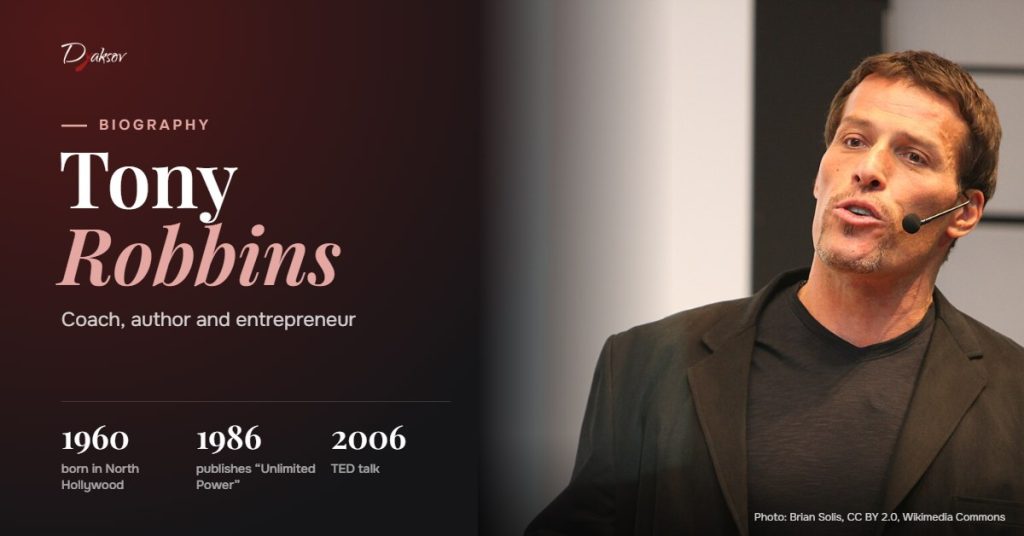
Tony Robbins was born Anthony J. Mahavoric on 29 February 1960 in North Hollywood, California, the eldest of three children. His childhood was hard: the family was poor and unstable, his parents split when he was 7, and he was later adopted by his stepfather Jim Robbins, whose surname he still carries.
At 17 he left home, worked as a janitor and never went to college. By his own account he was earning about 40 dollars a week, yet saved up and paid 35 dollars to attend a seminar by Jim Rohn, one of the personal development teachers of the time. That event changed his life. Soon after, he started working for Rohn and selling his seminars.
Seminars and books
Robbins studied behavioural psychology, neuro-linguistic programming and persuasion techniques and developed his own approach. His seminars are famous for high energy, music, dancing and the fire walk, a symbol of overcoming fear.
- Unlimited Power (1986);
- Awaken the Giant Within (1991);
- Giant Steps (1994);
- Money: Master the Game (2014);
- Unshakeable (2017, with Peter Mallouk);
- Life Force (2022, with Peter Diamandis and Robert Hariri);
- The Holy Grail of Investing (2024, with Christopher Zook).
His latest books show a shift from motivation towards personal finance, investing and health.
"Why we do what we do": the TED talk
In February 2006 Robbins took the stage at TED in Monterey. His talk lasts about 21 minutes and became one of the most watched in TED's history:
Two invisible forces
According to Robbins, our behaviour is shaped by two forces. The first is our state, physical and emotional. The second is our model of the world: our beliefs about what is possible and what everything that happens to us means.
He also says something I like a lot as an entrepreneur: the defining factor of success is never resources, it is resourcefulness. A lack of money, contacts or time is rarely the real reason we fail to achieve something. More often, we have not found a way.
The six human needs
- Certainty: avoiding pain and having comfort.
- Uncertainty and variety: surprise and change.
- Significance: feeling important, unique and needed.
- Connection and love: belonging and being loved.
- Growth: constantly developing.
- Contribution: giving beyond ourselves.
He calls the first four the needs of the personality and the last two, growth and contribution, the needs of the spirit. Real fulfilment, he says, comes from them.
Three decisions
At every moment we make three decisions that shape our lives: what to focus on, what it means and what to do. Robbins ends with a question I often ask myself in hard times: is this the end or a new beginning?
When I first watched the talk, I was struck by how useful an understanding of human motives is for anyone who leads people. If you know which of the six needs matters most to your employee, client or partner, you will understand their behaviour much better.
Tony Robbins' businesses
Robbins has built a business empire around seminars, coaching and books. He also invests: he is a co-owner of Los Angeles FC (since 2014) and of the esports team Team Liquid, owns the Namale resort in Fiji, and in 2024 launched a hotel brand with Sam Nazarian.
In 2016 Netflix released the documentary "I Am Not Your Guru", an inside look at his "Date with Destiny" seminar.
Philanthropy
His Anthony Robbins Foundation was set up in 1991. His best-known cause, however, is fighting hunger. Together with Feeding America he set a goal of 1 billion meals by 2025 and reached it almost two years early, in November 2023. On 21 April 2025 he launched the Next Billion Meals Challenge, aiming for another 1 billion meals in the US by 2035.
A fact connected to my own experience: in 1997 Tony Robbins was named one of the Ten Outstanding Young Persons of the World (TOYP) by JCI. In Bulgaria we organised this award from 2015 onwards.
Criticism and controversy
Talking only about success would be incomplete. Robbins' methods are often criticised as overly emotional and commercial, and his seminars and personal coaching are very expensive. At fire walks in 2012 and 2016 some participants reported burns, which his team said were less serious than described.
In 2019 BuzzFeed News published an investigation alleging inappropriate behaviour towards participants and staff. Robbins firmly denied the allegations and filed a lawsuit in Ireland. Everyone can judge these facts for themselves, but I think it is important to know them when we talk about people who inspire millions.
Personal life
Robbins has been married twice. Since 2001 his wife has been Sage Robbins; they live in Florida and have a daughter born in 2021. He also has a son, Jairek Robbins, who works in personal development too.
What can we learn from Tony Robbins?
- Invest in yourself. One week's pay spent on a seminar changed his life.
- Resourcefulness beats resources. Start with what you have.
- State drives action. Energy, health and habits are the foundation of productivity.
- Understand people's motives. The six human needs are a great tool for leaders, managers and salespeople.
- Give. Growth and contribution bring deeper fulfilment than money.
Photos: Brian Solis (CC BY 2.0), via Wikimedia Commons.
Petar Dyaksov
Entrepreneur, investor and managing partner at SEOMAX, with more than 15 years of experience in e-commerce and digital marketing. He builds businesses in technology and e-commerce, invests in companies and supports entrepreneurs. Speaker, trainer and mentor at dozens of conferences, seminars and entrepreneurship programmes.
More about me