Gold Investing Basics: What You Need to Know

Contents · 6 sections
The war in Ukraine, which began in late February 2022, piled more tension and uncertainty on top of what the pandemic and rising inflation had already created. In such a turbulent economy, it’s only natural that people looked for ways to protect their savings. One option that investors and ordinary people alike turn to at times like these is investment gold.
In the days after it became clear that the Russian army had invaded Ukraine, lines formed outside banks and precious metals dealers here in Bulgaria, full of people waiting to get their hands on gold.
Online platforms that sell investment gold also saw a surge in orders for gold bars and coins. Many popular products sold out fast, and buyers had to wait weeks to get them.
Strong global demand pushed the price up, of course. In early March gold reached $2,043 an ounce, about 13% higher than at the start of 2022, when it traded at $1,800 an ounce.
It’s one more example of how gold has proven itself, year after year, as a reliable alternative asset for preserving value.
For almost all of human history, gold has been a store of value. Since ancient civilizations such as the Egyptians and the Incas, the precious metal has been highly prized and has stood as a symbol of wealth. For centuries, many nations minted gold coins and used them as official currency.
That broad agreement about gold’s worth, together with its physical properties (which we’ll look at in detail below), is part of what makes gold such a valued asset.
Like any investment, buying gold calls for careful research and a clear look at the risks. This article isn’t financial advice, but it will give you useful information about gold as a safe haven for your savings.
We’ll also look at the different ways to invest in gold, physical or digital. Finally, you’ll find practical tips for buying physical investment gold, along with examples of popular, in-demand gold products you’ll see in many investors’ portfolios.
If the topic interests you and you want to learn more, read on!
Gold as an investment and a store of value
Thanks to its unique properties, the yellow metal has earned its place in investors’ portfolios and its reputation as a safe haven and a hedge against inflation. Let’s take a quick look at what makes gold special.
First, gold has to be mined and refined, and there is only so much of it. Modern currencies, by contrast, could in theory be printed without end. That scarcity is one of the reasons gold is so highly valued and holds its worth.
Another big advantage is that a small amount of physical gold can hold a lot of value. That makes it relatively easy to carry, so you can move value from place to place when you need to.
Historically, gold has not only held its value but grown it over time. That is one of the main reasons the precious metal is a good hedge against inflation and currency swings.
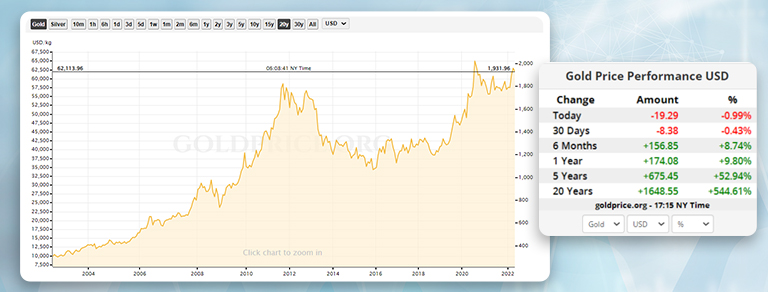
(Source: https://goldprice.org)
Take the Russia-Ukraine conflict again. The economic sanctions Western countries imposed on Russia sent the ruble into a temporary collapse. In early March the exchange rate hit 138 rubles to the dollar.
In an economic emergency, when currencies are unstable and losing value, people who keep all their savings in cash in a single currency can lose a big part of them very quickly. At the same time, the price of gold tends to rise, which protects the value of money invested in it.
On top of all that, gold has another quality investors count on: liquidity. In other words, you can sell it fairly quickly and turn it back into cash.
One more important advantage belongs on the list. Unlike many other investments, gold isn’t taxed in Bulgaria.
These are some of the reasons gold remains a reliable choice for long-term investing and preserving value. If you decide to put part of your savings into gold, one of the first questions you’ll face is whether to buy physical investment gold or digital gold. Below we’ll look at the differences and at the pros and cons of each.
Physical investment gold and other ways to invest in gold
Investing in physical gold means buying and storing gold coins or bars. You can also buy gold online through a broker or other intermediary without ever holding it. Other options include gold ETFs (exchange-traded funds), mutual funds with exposure to gold, and shares in mining companies.
To decide which route to take, weigh the pros and cons of each. Here is a quick summary.
Pros and cons of investing in physical gold
One downside of physical gold is that it costs more. The price includes the costs of minting, packaging, shipping, storage and so on, on top of the gold itself. You’ll also pay a markup to the dealer who sells you the bars and coins.
Another challenge with physical gold is where to keep it. Gold is a strong, durable metal, but you still need to store it properly so you won’t have trouble selling it later. If the amount is small, you can keep it at home. In that case, choose a safe hiding place and don’t tell anyone exactly where it is. Unfortunately, keeping gold at home also means living with the risk of burglary and theft.
For larger amounts, one solution is a bank safe deposit box or vault. That option comes with extra costs, though, and some limits on when you can get to your gold.
Of course, owning physical gold has its advantages too. The biggest is that you actually hold your investment, which gives you more security in an emergency. Think of an extreme situation like a war, when ATMs stop working and banks may make it hard for people to get to their money.
Bad exchange rates can be a problem, too. At times like these, physical gold, which is easy to carry, lets you take your wealth with you and, if needed, sell it at close to the market price.
Many gold bars and coins have published buy and sell prices (tied to the current price of gold), and licensed dealers will buy these products back.
Pros and cons of investing in non-physical gold
Buying gold online through a broker or platform combines the flexibility of investing in stocks with the simplicity of investing in gold. One big advantage is how easy it is to buy on any of a number of platforms, such as Interactive Brokers, Revolut, Paysera and others.
You buy the gold at the market price. There may be a fee for the transaction itself, but you don’t pay for minting, shipping and so on, so it naturally costs less than physical gold.
Non-physical gold also solves one of the biggest headaches of physical gold: you don’t have to worry about where and how to store it. Another plus is that you can invest any amount you like. With coins or bars, on the other hand, you’re limited to the sizes they come in: 1 ounce, ½ ounce, 5, 10, 20, 50 or 100 grams and so on.
You can also invest in a gold ETF that tracks the price of gold. Popular ones include SPDR Gold Shares and iShares Gold Trust. Buying gold online through a broker or an ETF carries the risk that the intermediary (or intermediaries) goes bankrupt. The price of the ETF can also drift away from the price of physical gold.
Another option is a mutual fund with exposure to gold or mining companies, so you don’t have to track the price of the metal yourself. These funds usually charge management and entry fees, though.
You can also buy shares in mining companies, whose prices depend heavily on the price of gold. But it’s wise to understand stock trading well before you go this route.
To sum up, physical gold is best for long-term investing, while non-physical gold can be held for shorter periods and sold in literally seconds.
Tips for buying gold coins and bars
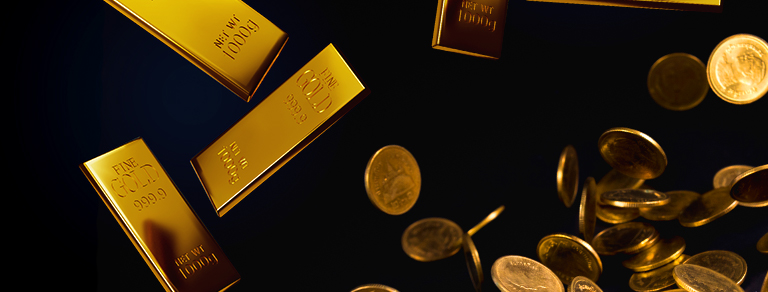
If you’ve decided on physical gold, here are some practical tips for choosing the right coins and bars for your portfolio.
One piece of advice you’ll hear from many experts is to stick with popular products. They are more liquid, so they’re easier to sell. Later in this article we’ll look at some of the best-known and most popular gold bars and coins.
Should you buy heavier pieces? There are two sides to consider. On one hand, the heavier the product, the closer its price is to the market price of gold, so you get more for your money. On the other hand, when the time comes to sell, it may be a bit harder, because you need a buyer for the whole piece.
Experts also recommend looking for products with a narrow spread between the buy and sell prices.
Storing your gold properly matters, too, if you want to protect the value of your investment. After you buy coins or bars, leave them in their original packaging. Taking them out can damage them and make it harder for dealers to buy them back.
Just as important is where you buy your gold. Your options include some banks, licensed gold dealers and even private individuals. Buying from official, licensed dealers guarantees that you’ll get products of proven authenticity and quality.
Be especially careful if you buy anywhere else. A price well below the market price can be a sign of fraud. So always do your homework and look for reliable, licensed dealers.
Personally, I’ve bought gold from Limar24 (a Bulgarian gold dealer), both for myself and as gifts, and I’ve been very happy with them. To me, an investment coin or bar (even a modest one) makes a far better gift than, say, a piece of gold jewelry.
Popular gold investment products
Investment gold traditionally comes in two main forms: coins and bars. Below I’ll briefly introduce some of the most popular ones, the ones investors reach for most often.
Popular investment coins
- Vienna Philharmonic: one of the most popular gold investment coins, and more than once the best-selling gold coin in the world. It’s made by the Austrian Mint and, as the name suggests, it honors one of Austria’s national symbols, the Vienna Philharmonic. One side shows eight orchestral instruments, and the other shows the great organ in the Philharmonic’s concert hall.
- Australian Kangaroo: another popular, highly liquid gold coin. What makes this modern investment coin special is that its design changes every year, which also makes it tempting for collectors. Every design, though, features Australia’s national animal, the kangaroo.
- Napoleon: the 20-franc Napoleon III gold coin also deserves a look. With almost 6 grams of gold and an elegant design, it has become one of the coins collectors have sought most in recent years.
- Canadian Maple Leaf: made by the Royal Canadian Mint, this coin is known for its advanced security features, designed to make counterfeiting as hard as possible. That extra reliability, and the easier resale that comes with it, makes it a favorite for many buyers.
- Austrian ducats: these coins also come from the Austrian Mint, one of the oldest in Europe, which is why its products are in such high demand. The 1-ducat and 4-ducat coins show Emperor Franz Joseph, the longest-reigning Austrian monarch, on the front.
Gold bars
In Bulgaria, the most popular gold bars come from two of the best-known Swiss refineries: Valcambi and PAMP.
Valcambi is one of the younger Swiss refineries, founded in the 1960s. Even so, it has built a solid reputation and set itself apart from the competition.
Valcambi bars are known for their high quality and simple design, and they come with a certificate, which makes proving their authenticity easier than with coins. The Swiss refinery offers cast gold bars in a range of sizes, from one gram up to one kilogram.
One interesting product is the 1-ounce Valcambi bar, designed to compete head to head with 1-ounce investment coins. It is also highly liquid.
PAMP Suisse is one of the best-known names in precious metals, and it runs one of the largest precious metals refineries in Switzerland. PAMP bars are made to the highest industry standards, which is why investors around the world trust them and demand for them is high.
Based in Ticino, the Italian-speaking part of Switzerland, the company has long been a leader in investment bars. PAMP is famous for being the first to put an image on the front of a bar, when it launched its PAMP Fortuna line.
Like Valcambi, PAMP offers gold bars from 1 gram to 1 kilogram. All PAMP gold bars are 24-karat gold with a purity of 999.9. The PAMP Fortuna series is the most popular in its range.
The bars show Lady Fortuna on the front, and the series was the first line of gold bars to carry an artistic image. The back of each bar has the PAMP logo at the top, with the bar’s weight, purity and serial number below. The brand’s best-selling bar is the 1-ounce piece from this very series.
Is gold jewelry an investment?
In Bulgaria and the rest of the region, many people still see buying gold jewelry as an investment. But is it really? The short answer is no. Here’s why.
First, the law clearly defines what counts as investment gold, both its form and its purity. Gold in the form of coins (round) and bars (rectangular) is investment gold.
The law also sets a purity threshold: above 995 parts per 1,000 for bars and above 900 (about 21.6 karats) for coins. Gold jewelry doesn’t meet these requirements, which is why it doesn’t count as investment gold.
Dig a little deeper and you’ll see that jewelry gold is far less pure. Jewelry is usually around 14 karats (58.33% pure gold), while investment gold products, as I mentioned, are traditionally around 24 karats (nearly 100% pure gold).
On top of that, the price of jewelry usually includes labor and the retailer’s markup, which pushes up what you pay for the finished piece.
If you want to invest in gold, go for high-purity gold coins or bars.
Conclusion
Over the years, gold has proven itself a relatively safe store of value. Its price moves in cycles of ups and downs, and there are periods when it loses value. But historically, over the long run, gold has not only held its value but grown it. That makes it a low-risk investment and a popular way to diversify a portfolio.
Keep one more thing in mind, though: historically, gold has returned less than stocks and other higher-risk assets.
It’s a good idea to buy gold when its price is falling or flat, because it’s in times of uncertainty, such as a recession, a war or another external shock, that the price of gold has traditionally gone up.
This article is not investment advice, and I am not an investment advisor. The price of gold moves, and like any investment, gold carries risks. So if you’re planning to take this step, do your own research, look carefully at the risks and, ideally, talk to a specialist who can help you make an informed decision.
Petar Dyaksov
Entrepreneur and founder of a digital agency, in e-commerce since 2009. He grows online businesses such as Fragrances.bg and Timedix and shares his experience as a speaker, moderator and mentor at nearly 80 conferences and trainings.
More about me