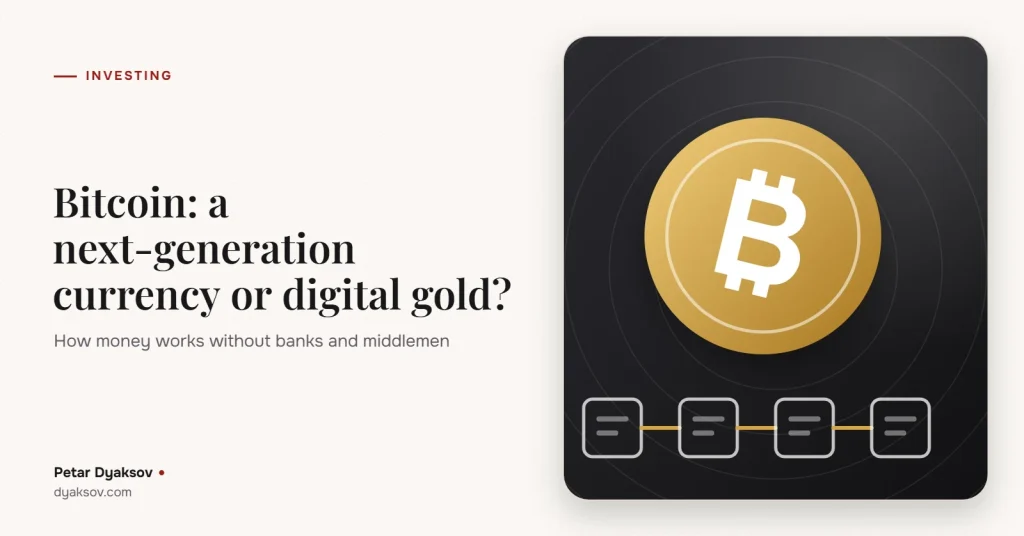
Bitcoin: a next-generation currency or digital gold?

Contents · 9 sections
When I published the first version of this article in February 2015, one bitcoin cost about 250 dollars, and most people saw it as an experiment for computer enthusiasts. Ten years later, Bitcoin is an asset with a market capitalisation of around 1.8 trillion dollars, it trades through exchange-traded funds in the US, and it has its own regulation in the European Union and in Bulgaria.
In this updated version we look at how Bitcoin works, what has changed in recent years, how gains are taxed in Bulgaria and how to approach it sensibly if you are thinking of investing. Remember that this is not investment advice, but shared experience and information.
What is Bitcoin?
Bitcoin is a decentralised digital currency that is not issued or controlled by a central bank or a state. The protocol was described in 2008 by an author (or group of authors) under the pseudonym Satoshi Nakamoto, and the software launched in January 2009. Satoshi disappeared from public view in 2011, and his identity is still unknown.
All transactions are recorded in a public ledger called the blockchain. It is maintained by thousands of computers around the world, not by a single institution. That is what makes it resistant to censorship and outside interference.
How does Bitcoin work?
Blockchain and mining
Transactions are grouped into blocks, and a new block is added on average every 10 minutes. The computers that verify transactions and add blocks are called miners. They solve a complex mathematical problem, and the first to succeed gets a reward in new bitcoin plus the fees from the transactions in the block.
In 2015 I wrote that mining had already moved from ordinary processors to graphics cards and specialised devices (ASICs). Today mining is an industry with huge data centres and is practically out of reach for home users.
The halving and the limited supply
The total number of bitcoin is capped at 21 million. About every four years, the miners' reward is cut in half. The latest, fourth halving took place on 20 April 2024, when the block reward fell from 6.25 to 3.125 BTC. As of November 2025, almost 20 million bitcoin have been mined, and the last ones will be mined around 2140.
This predictable, limited supply is the main reason many investors call Bitcoin "digital gold".
Pros and cons
- Pros: it works 24/7, with no days off; transfers between countries are fast; there is no central authority that can freeze your account; the supply is transparent and limited.
- Cons: high volatility; a lost key means lost money; transactions cannot be reversed; high energy use; it is still rarely used for everyday payments.
A short history of market cycles
Bitcoin's price moves in cycles, often linked to the halvings:
- 2017: the first big boom, with the price approaching 20,000 dollars in December, followed by a drop of more than 80% in 2018.
- 2021: a new high above 69,000 dollars on 10 November 2021, followed by a tough 2022 and the collapse of the FTX exchange.
- 2024 and 2025: the approval of exchange-traded funds and the halving started a new cycle. On 6 October 2025, Bitcoin set a record of around 126,000 dollars.
Just six weeks later, on 18 November 2025, the price fell below 90,000 dollars for the first time in seven months, almost 30% below the peak. It is a good reminder that even after ten years, Bitcoin is still an extremely volatile asset.
The institutions are here
The biggest difference from 2015 is that Bitcoin is no longer just for enthusiasts.
- Exchange-traded funds (ETFs): on 10 January 2024, the US regulator approved 11 spot bitcoin ETFs. By November 2025, their assets had reached about 120 billion dollars.
- Companies with bitcoin on their balance sheet: the best-known example is Strategy (formerly MicroStrategy), which held almost 650,000 BTC as of mid-November 2025.
- Countries: on 6 March 2025, the US President signed an executive order creating a strategic bitcoin reserve funded with seized assets.
Regulation in Europe and in Bulgaria
The European Union now has the MiCA regulation (Markets in Crypto-Assets). It entered into force on 29 June 2023 and has applied in full since 30 December 2024, including the requirement for crypto-asset service providers to be licensed.
On 20 June 2025, the Bulgarian parliament also adopted the Crypto-Asset Markets Act. Under it, the Financial Supervision Commission (FSC) licenses and supervises these service providers, and firms registered with the National Revenue Agency so far have a transition period until 1 July 2026. For you as a user, this means one thing: choose platforms licensed under MiCA.
How are Bitcoin gains taxed in Bulgaria?
For individuals, the gain from selling or exchanging cryptocurrency is treated as income from transactions in financial assets and taxed at 10%. The tax applies to the difference between the sale price and the purchase price, and gains and losses during the year are added together.
The income is declared in the annual tax return, in Annex 5, by 30 April of the following year. If you trade systematically as your main activity, the treatment may differ. For larger amounts, I recommend talking to an accountant.
The risks you need to know about
- Volatility: drops of 30% within weeks and of 70-80% in a bear market have happened many times.
- Scams: fake platforms, "guaranteed" returns, calls from "brokers" and ads featuring celebrities. If someone promises you a sure profit, it is a scam.
- Losing access: if you lose the keys or the recovery phrase of your wallet, no one can get your funds back.
- Platform risk: the collapse of FTX in 2022 showed that money held on an exchange is not entirely yours.
How to buy Bitcoin safely
- Use a licensed provider under MiCA and check the register of the FSC or the relevant European regulator.
- Turn on two-factor authentication and never share your passwords or recovery phrase.
- For larger amounts, consider a hardware wallet, where you hold the keys instead of the exchange.
- Buy in parts over a period of time instead of all at once. This reduces the risk of buying at the top.
- Invest only money you can live without, and keep the records of every purchase for your tax return.
My view today
In 2015 I ended the article by calling Bitcoin a next-generation currency. Today I would say it has become an alternative store of value rather than a currency for everyday payments. The technology has proven it can survive several severe crises, and institutional adoption is a fact.
At the same time, I would not put money into Bitcoin that I will need in the next few years. For me it can be a small part of a portfolio, alongside stocks, bonds and gold. If the topic interests you, also see my articles on investing in gold and on managing your personal finances.
This article is for information only and is not investment advice. Every investment decision is your own responsibility.
Petar Dyaksov
Entrepreneur, investor and managing partner at SEOMAX, with more than 15 years of experience in e-commerce and digital marketing. He builds businesses in technology and e-commerce, invests in companies and supports entrepreneurs. Speaker, trainer and mentor at dozens of conferences, seminars and entrepreneurship programmes.
More about me